
For a brand, there are many ways to make contact with prospects and convert them into customers. Inbound marketing in particular has been bringing a breath of fresh air to the relationship between businesses and their audiences for several years now. What does inbound marketing offer that is new? What advantages does it provide?
What Does Inbound Marketing Offer Compared to Traditional Marketing?
Traditional Marketing
First, let us revisit traditional marketing, also known as outbound marketing. These traditional approaches focus on seeking out customers and use so-called interruptive and "intrusive" techniques: telephone calls, print or television advertising, mass emailing, and so on. Prospects who encounter the brand's message have not necessarily chosen to do so. As a result, these methods face new barriers. Unknown telephone calls get blocked. Catch-up services, streaming, and time-shifted viewing allow people to avoid television advertising. Email servers classify mass sends as spam. While it is still possible to reach your target audience through these means, it does require a certain investment. Moreover, traditional marketing is focused on a commercial aspect — product-centric.
Inbound Marketing — Definition and How It Works
Inbound marketing takes the opposite approach to these two aspects. With inbound marketing, the goal is to be found by users rather than going out to find them. So, instead of commercial emails, inbound marketing will involve setting up a blog. Instead of telephone prospecting, the focus will be on managing a company page on a social network. In short, instead of imposing advertising on the public, inbound marketing attracts prospects to the brand. The second essential component of inbound is that the content is user-oriented rather than product-oriented. Internet users who encounter a particular problem search for a solution online and find the blog or social media page for your brand. They see that your content addresses their challenges rather than trying to sell them your product. Subsequently, the internet user who likes the content they see will contact your brand themselves if they want more information, or when they are ready to take the next step in their buying process. After all, a brand that speaks to users and gives them advice can only be better perceived by prospects than a brand that focuses solely on selling its products. It should be noted that inbound marketing is not intended to replace traditional marketing. The idea is rather to take the best that each approach can offer your brand and optimise their combined effects.
How Inbound Marketing Works in 4 Steps
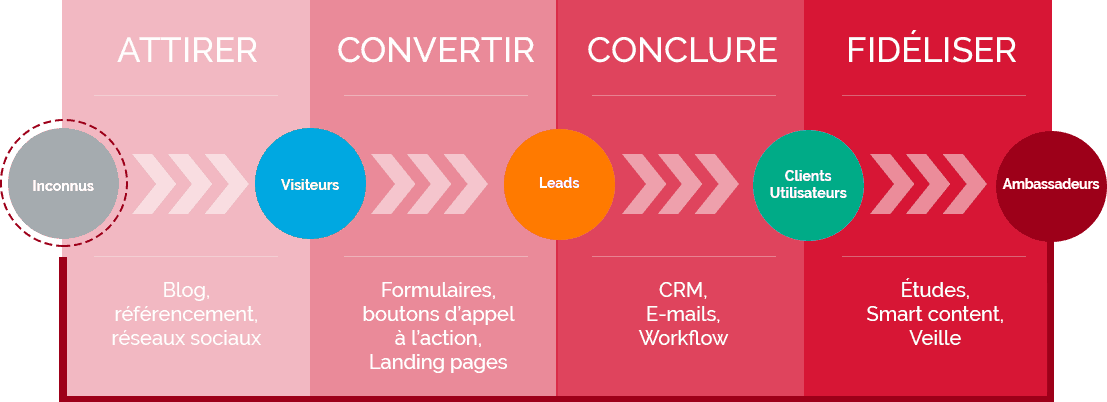
We have now defined inbound marketing in theoretical terms. To make things clearer, let us detail the 4 main steps of the process: Attract, Convert, Close, Delight.
1. Attract
The first step is to attract strangers to your brand and turn them into visitors. To do this, natural search engine optimisation, a regularly updated blog, and your presence on social media are the 3 tools that will serve you well.
2. Convert
Once new visitors are on your website, the next step is to convert them into leads by gathering information about them. At this stage, obtaining an email address is essential. But they will not give you this information for free. You need to have something to offer in return — a value exchange. You need to offer them something, a piece of content — called an Offer — that they will want to obtain. Ebooks, whitepapers, tip sheets, videos — the types of content possible are numerous and could not be fully listed here. The goal is to provide content that is relevant and interesting to your visitors. This is where the conversion path — a term we will encounter again in our explanations of inbound marketing — begins.
3. Close
The visitor is now a lead. They have followed the link to a dedicated landing page to obtain your Offer (ebook, whitepaper, etc.) in exchange for their email address. The third step is therefore to close — to turn this lead into an actual customer. This step can vary in duration depending on the type of lead (the mindset of the Buyer Persona). Through emails and customer relationship management (CRM), for example, you will be able to sell to the right lead at the right time.
4. Delight
Inbound marketing involves offering relevant content to your users, whether they are visitors, leads, or even existing customers. Closing the sale is not the final step of inbound marketing. The goal is also to continue adding value for your existing customers in order to ensure their loyalty. Finally, these loyal, satisfied customers can become brand ambassadors. They will promote your brand of their own accord, spreading the word to those around them and thereby bringing new visitors, leads, and future customers to your site. One step that does not feature in the diagram is analysis — and this is intentional. Analysing results and the methods used is not something that happens at a specific point in time. It is a permanent state of mind. It is the only way to see what is working, which types of content perform better than others, and so on. Opting for inbound marketing will open up an entirely new approach to both your prospects and your existing customers. We will soon deepen our exploration of this new approach with the concept of Buyer Persona.
YOU MAY ALSO BE INTERESTED IN
UGC, the Future of Marketing: How User-Generated Content Can Revolutionise Your Marketing Strategy
by Yumea, 7 March 2023
UGC (User Generated Content) is changing the game in the world of marketing. With the rise of social media and content-sharing platforms, the... READ MORE
Category: News , Getting Visible Online , Social Media
Comments: 0
How to Use Instagram to Reach Your Audience and Drive Traffic to Your Website?
by Yumea, 1 February 2023
Social media has become an indispensable tool for businesses looking to reach their target audience and drive traffic to their website. With more than 3.8 billion active users... READ MORE
Category: Getting Visible Online , Instagram , Social Media
Comments: 0
7 Artificial Intelligence (AI) Tools You Need to Know in 2023
by Yumea, 12 January 2023
In 2023, there are numerous websites that use artificial intelligence (AI) to help users write content and generate images. If you are looking for tools to help you write... READ MORE
Category: News
Comments: 0