
A Buyer Persona is a typical client — the ideal customer you want to target. Based on concrete research, this semi-fictional representation allows you to tailor your content and messaging to make them more effective. But there is a particularly important concept linked to the Buyer Persona: the Buyer's Journey.
What is the Buyer's Journey?
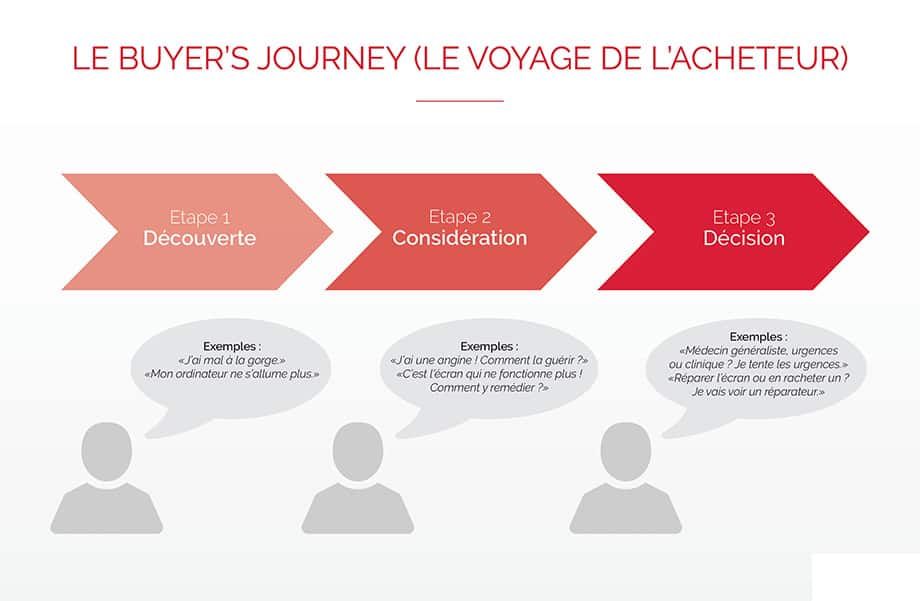
The Buyer's Journey represents the active research process we go through before making a purchase. Knowing where your Persona is in the stages of this journey is essential for producing the best possible content. The Buyer's Journey consists of 3 stages through which every buyer passes: awareness, consideration, decision. Everyone has already gone through this kind of journey — the path between the moment we look for potential solutions to a problem and the moment we choose a specific solution.
Awareness
At this stage, the prospect experiences or expresses the symptoms of a problem or an opportunity. Something has disrupted the status quo, or the prospect wants to change something in their day-to-day life of their own accord. They carry out research to find out more, understand what is going on, and clearly grasp their situation. Let us take a concrete example. You have been ill at some point or another. You went through this first stage where you did not feel well without really knowing why. You have a fever, a sore throat, and aching all over. You wonder what is wrong with you and search for your symptoms to find a solution. This is typically the awareness stage. Another example would be a laptop that no longer switches on. What is wrong with it?
Consideration
At this point, the prospect has clearly identified their problem or opportunity. They are now looking for which solutions are available to resolve their situation. Returning to the same examples: you are ill and have looked up all your symptoms — you now realise you have tonsillitis. Now, you naturally want to find out which treatment or medication will help you. In the case of the laptop that will not switch on, you understand that it is the screen that is no longer working even though the device itself is on. What can you do to bring your screen back to life?
Decision
The final stage of the journey. The prospect has decided on a strategy, method, or approach to solve their problem. They list and compare the options that match their chosen solution. They may also seek to narrow down their possibilities and ultimately finalise their purchase decision. Still using the same examples: now that you know you have tonsillitis, you list your options: see a GP, go to A&E, visit a clinic. A&E is expensive but you have insurance. Your mind is made up. In the case of a laptop with a faulty screen, you could decide to buy a new one or take it to a repair shop. You value the data on your laptop and don't particularly want to change it, so a repair shop will be ideal. As you will have gathered, the aim is to put yourself in the shoes of your prospects and see things from their point of view.
Content adapted to each stage
The illness example is particularly instructive. When you visit a doctor, they study your symptoms, explain the various options, and prescribe a solution. But what if the doctor showed no interest in your symptoms and simply prescribed medication straight away? There is a strong chance that the experience would be far from pleasant. The same logic applies to your website. Rather than creating content that discusses prospects' problems and possible solutions, many websites skip straight to the final stage and explain how their product or service is the best available. A visitor can arrive on your website at any point in their journey — whether they are in the awareness, consideration, or decision stage. Your website must offer different pieces of content that each address one of these stages. This way, you will be able to satisfy your visitors, whatever stage they are at. Here we find the very foundation of inbound marketing: creating educational content that informs internet users about their solutions and problems — not about who you are or what you do. It is a way of building trust with your prospects.
Content + Context: the key to inbound marketing
As we have seen, content is an essential element of inbound marketing. But more than just content, you need "contextualised" content. Context is the reason why you write a particular piece of content. It is not enough to simply create content — you must create adapted content for the right people: content that targets specific individuals and addresses subjects that interest them. The best content — the content that will fuel your inbound strategy — must be produced in the right context, meaning for the people you are targeting (your Buyer Personas) and written around what interests them most (according to the stage they are at in their Buyer's Journey). For example, in the case of the faulty laptop, one article might be aimed at Personas in the awareness phase and titled "Why has my laptop stopped turning on?", a second for those in the consideration phase, "Cracked screen, failed graphics card: how do I repair my laptop screen?". For the final phase, the decision, an article might present a case study about a customer who trusted your brand to repair their laptop. Context also encompasses the distribution of your content. Emails, social media, blogging — the goal is to use the right communications tools to make your content appear in front of the right people at the right time. Take care to distribute your content where your Personas actually are. For example, if they never go on Twitter, that social network will not be a major part of your distribution strategy. On the other hand, if your Personas spend their time on Facebook, you should definitely give it a prominent place in your decisions. To summarise: the Buyer Persona is essential to an inbound marketing strategy. Research, develop, and use your Personas. Then create different pieces of content to reach your Personas at each of the 3 stages of their journey, and distribute that tailored content in the appropriate channels.
YOU MAY ALSO LIKE
UGC, the future of marketing: How user-generated content can revolutionise your marketing strategy
by Yumea, 7 March 2023
UGC (User Generated Content) is changing the game in the world of marketing. With the rise of social media and content-sharing platforms, users are… READ MORE
Category: News , Getting visible online , Social media
Comments: 0
How to use Instagram to reach your audience and drive traffic to your site?
by Yumea, 1 February 2023
Social media has become an indispensable tool for businesses looking to reach their target audience and drive traffic to their website. With more than 3.8 billion active users… READ MORE
Category: Getting visible online , Instagram , Social media
Comments: 0
7 Artificial Intelligence (AI) tools to know in 2023
by Yumea, 12 January 2023
In 2023, there are many platforms using artificial intelligence (AI) to help users write content and generate images. If you are looking for tools to help you write… READ MORE
Category: News
Comments: 0