
To optimise your site, it is essential to choose a list of strategic keywords and key phrases that will help you achieve the best possible ranking on search engines. Using a very short, high-volume keyword will rarely bring meaningful visibility to your site. On the contrary, for natural SEO, we believe the best approach is to use long-tail keywords — less frequently used but more specific — in order to best reach your target audience and thus attract significant, and above all quality, traffic.
Here are 8 simple, practical methods for finding long-tail keyword ideas based on your content, with the objective of optimising your site.
Method 1: Via Google
This is the simplest method for finding long-tail keywords.
Start by searching Google for a generic keyword. For example, "computer":

Scroll down to the bottom of the page and look for "Related searches."
This gives you long-tail keywords that will allow you to be more specific with your article during natural SEO, thus better targeting your visitors.
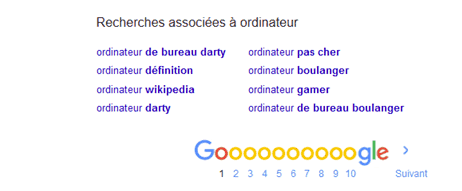
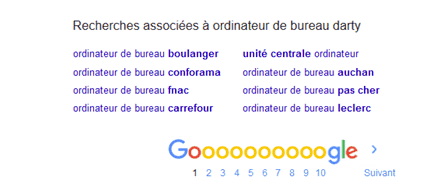
You can even go further by clicking on one of the keywords to obtain new, even longer keywords.
Method 2: Via forums
Forums allow you to find out which keywords are frequently used by internet users. They provide valuable information that helps in finding targeted long-tail keywords.
To save time, there is a simple technique for finding forums relevant to your topic.
Go to Google and type "inurl:forum+" followed by the generic expression — for example, "sunglasses."

From these different forums, you can retrieve long-tail expressions such as "Sunglasses at the optician," "Quality sunglasses," or "Sunglasses for toddlers."
Method 3: On Amazon
Amazon is not just a product purchasing site — it is also an excellent search engine that will help you find long-tail keywords for your natural SEO.
Start by going to Amazon and typing a keyword — for example, "laptop" — into the search bar.

Alongside your keyword, you will find others that follow and complete it. Do not use your generic keyword on its own — opt for more specific expressions to improve the quality of your SEO. These words are a major advantage if you run an e-commerce site, as they are highly targeted and therefore have strong conversion potential.
Method 4: With Answer The Public
Interrogative phrases increase the chances of achieving good rankings on search engines. They are widely used by internet users, which is why you need to find the right questions — those that best match your topic — and rephrase them as long-tail expressions. To do this, you can use Answer The Public.
This tool searches for all the most frequently asked questions related to your chosen keyword. To use it, simply select your language and enter your base key phrase — for example: "how to choose a strong password." You will receive a tree diagram filled with the most commonly asked questions.
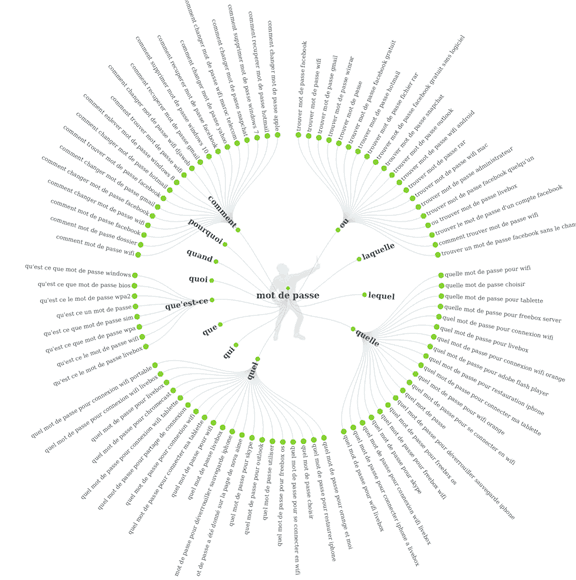
You will notice different types of diagrams, and if you click on Data you get the results in column format:
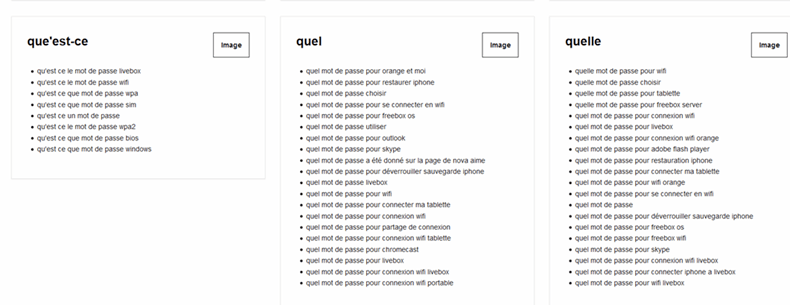
You will obtain a large number of questions — use them to transform them into long-tail keywords or key expressions.
Method 5: Using Google Adwords
Google Adwords is a paid tool but can be used for natural SEO purposes.
Google Adwords gives you the ability to reach the right people with the right keywords. Differentiate yourself by using those that best match your activity — specific enough not to be overly competitive, yet popular enough to be searched for by your target audience. The ideal is to find a key expression that is specific enough not to face too much competition, yet popular enough to be searched for by your target.
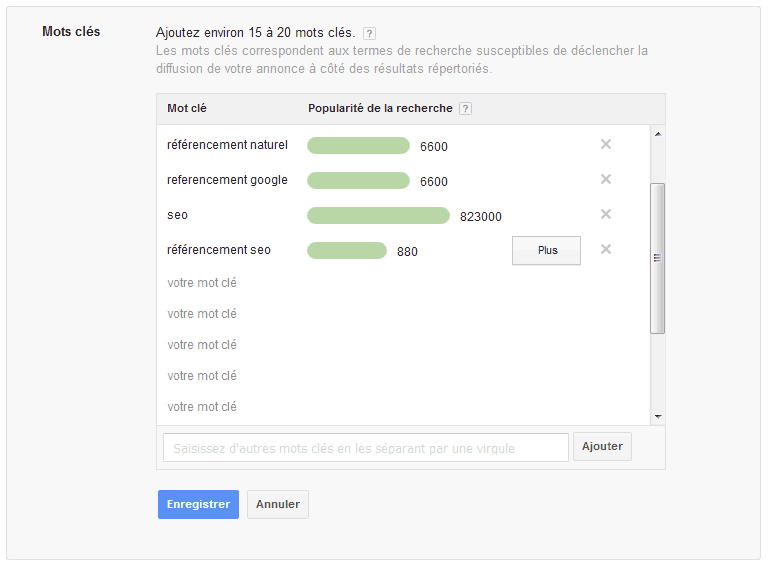
To do this, simply use your Google Adwords account (or create one for free if you do not already have one), launch a paid search campaign (do not worry — you will not have to pay anything for our method), and navigate to the section where you select your keywords (where the tool also suggests others and shows you the average number of searches per keyword).
In this section, enter the keywords you want and check their popularity, or click "More" to generate 3 new key expressions on your topic. Once you have the keywords you are looking for, simply cancel the campaign before reaching the payment step.
Method 6: Via Pinterest
This is not its primary function, but Pinterest can also be a useful long-tail keyword research tool.
To use it, create an account or log in with your Google account. Once on the homepage, type your keyword into the search bar — this will lead you to more specific categories that you can use to construct your final long-tail key expression.
For example, with "coffee table," you might get: reclaimed coffee table, wooden coffee table, unique coffee table…

Method 7: Use Google Correlate
This technique is little known, yet it offers genuine help for SEO.
Google Correlate allows you to find terms often used by the same people.
By adding the terms found to your main keyword, you will reach new people who are similar to your core target audience.
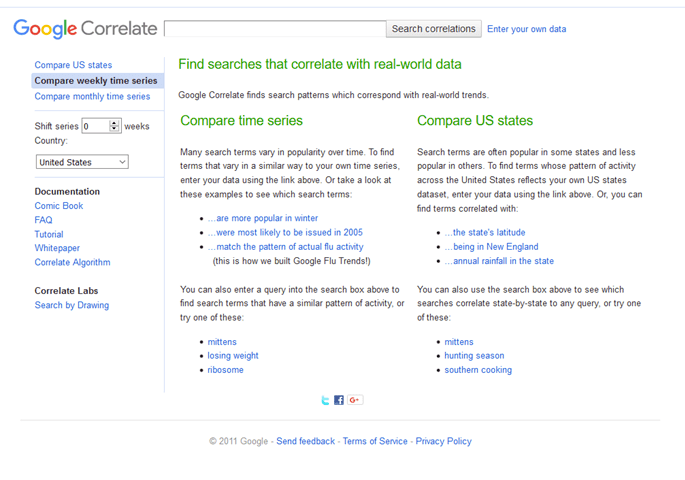
Once you reach the above screen, please select your country from the "country" dropdown.

Then type your keyword into the search bar and you will be able to see the terms most frequently used by the same people. Modify your base keyword with the suggested terms while staying within your topic area.
Method 8: Google Trends for related queries
Google offers us yet another tool in a different form: Google Trends. Here too, you will find popular expressions that most people are currently searching for, but based on your main keyword, your target audience, and your activity.
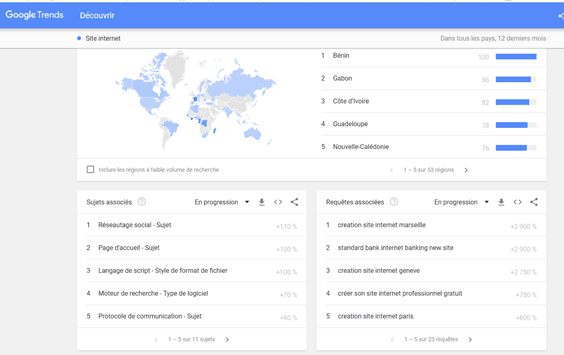
For example, if your main keyword is "website":

Scroll down and focus on the most commonly used key expressions in searches. Make your selection based on your target audience.
Feel free to combine these 8 methods to find the keywords and key expressions that best match your activity and target audience, to better boost your natural SEO and attract more visitors to your site.
YOU MAY ALSO LIKE
UGC, the future of marketing: How user-generated content can revolutionise your marketing strategy
by Yumea, 7 March 2023
UGC (User Generated Content) is changing the game in the world of marketing. With the rise of social media and content-sharing platforms, the... READ MORE
Category: News , Getting visible online , Social media
Comments: 0
How to use Instagram to reach your audience and drive traffic to your site?
by Yumea, 1 February 2023
Social media has become an indispensable tool for businesses seeking to reach their target audience and drive traffic to their website. With more than 3.8 billion active users... READ MORE
Category: Getting visible online , Instagram , Social media
Comments: 0
7 Artificial Intelligence (AI) tools to know in 2023
by Yumea, 12 January 2023
In 2023, there are many sites that use artificial intelligence (AI) to help users write content and generate images. If you are looking for tools to help you write... READ MORE
Category: News
Comments: 0