
Would you like to optimise the organic search performance of your website but are not sure how to go about it? Are you worried you may have made some SEO mistakes, or might make them again? Rest assured, you are not alone!
Today we look back at 5 of the most common SEO mistakes found across the web!
1. Broken links or links with no strategy
Links, or linking, are important both for SEO and for the user experience. They help push certain pages forward, leverage the visibility of third-party websites and guide your visitors to the pages you want them to reach.
Ideally, identify one or two pillar pages: the pages to which you want to direct your visitors. A service overview, an online shop, a booking or contact page — the nature of your pillar pages will depend on your objectives. All other pages, the supporting pages, should aim to lead back to the pillar pages as quickly as possible.
For example, a hotel website might publish blog articles (supporting pages) about regional or local events taking place near the hotel. These pages would link to a pillar page (the page describing the rooms in detail, or directly the booking page).
Finally, on fairly old or comprehensive websites, it is easy to accidentally break a link or delete a page while forgetting to remove the links pointing to it. Pay close attention to this: visitors hate landing on a dead link.
2. URLs that are too long or contain underscores
Both users and search engines prefer clear URL structures that are, if not short, at least an appropriate length. Excessively long URLs should therefore be avoided.
Likewise, use hyphens (the standard hyphen: –) and not underscores (_ ) in your URLs. Why? Because some search engines, including Google, do not consider an underscore to be a word separator.
To simplify: a page with the URL "restaurant_chinois_lyon" will only appear in Google results when someone searches for the exact string "restaurant_chinois_lyon". Searching for "Lyon restaurant chinois" will not return that page.
In practice, the content of the page also plays a role and can offset this issue. Some sites manage to rank well despite underscores in their URLs. But it is making life unnecessarily difficult for yourself. If your site is new or under construction, use hyphens to give yourself the best possible chance.
3. Duplicate content
Google hates duplicate content. How is it supposed to know which version to promote? Not to mention copyright and related rights. On the internet, it is very easy to tell whether you have copied content from a competitor. Aside from the legal risks, if your visitors notice that your content is a replica of another site, you lose their trust and their desire to stay on yours.
This is therefore strongly to be avoided. And it is unfortunately a very common mistake: according to a study of 100,000 websites and 450 million pages, 65% of sites use duplicate content at one point or another.
4. Missing meta descriptions
It is common to find websites that have not filled in the meta description for their pages.
Search engines do not pay particular attention to this field. But from a user perspective, it can become problematic.
If you do not fill in a meta description, it is the search engines that will decide which text to display in their results pages. Truncated words, fragments of sentences taken out of context, and so on — this type of preview will always be less appealing than a carefully crafted, concise description. This could well lead visitors to prefer a competing site on the search results page…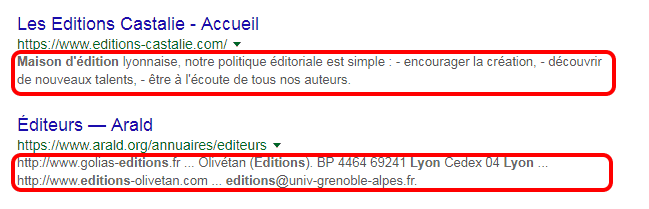
Which result would you rather click on? The one with a well-written, clear description, or the one with a description made up of links and truncated text?
5. Missing or overly long title tags
As with the meta description, not filling in your title tag leaves search engines free to display a title of their own choosing (truncated, inappropriate, etc.). A title that is too long will also be cut off.
From an SEO perspective, you can include a few strategic key phrases in your title tag (or SEO title). From a user perspective, think about your click-through rate! Visitors will always prefer to click on a complete, clear and coherent title rather than a line that cuts off too early.
We hope that these 5 of the most common SEO mistakes found online will help you avoid some of them and better understand certain aspects of organic search.
YOU MAY ALSO LIKE
UGC, the future of marketing: How user-generated content can revolutionise your marketing strategy
by Yumea, 7 March 2023
UGC (User Generated Content) is changing the game in the world of marketing. With the rise of social media and content-sharing platforms, the … READ MORE
Category: News , Getting visible online , Social media
Comments: 0
How to use Instagram to reach your audience and drive traffic to your website?
by Yumea, 1 February 2023
Social media has become an indispensable tool for businesses looking to reach their target audience and drive traffic to their website. With more than 3.8 billion active users … READ MORE
Category: Getting visible online , Instagram , Social media
Comments: 0
7 Artificial Intelligence (AI) tools to know in 2023
by Yumea, 12 January 2023
In 2023, there are many platforms using artificial intelligence (AI) to help users write content and generate images. If you are looking for tools to help you write … READ MORE
Category: News
Comments: 0