
Both terms come up everywhere, often used interchangeably, which makes it hard to know which one actually fits your need. A small business owner who wants to improve their customer relationship quickly runs into sales pitches that talk about "chatbot" or "AI agent" without ever explaining what that changes in practice.
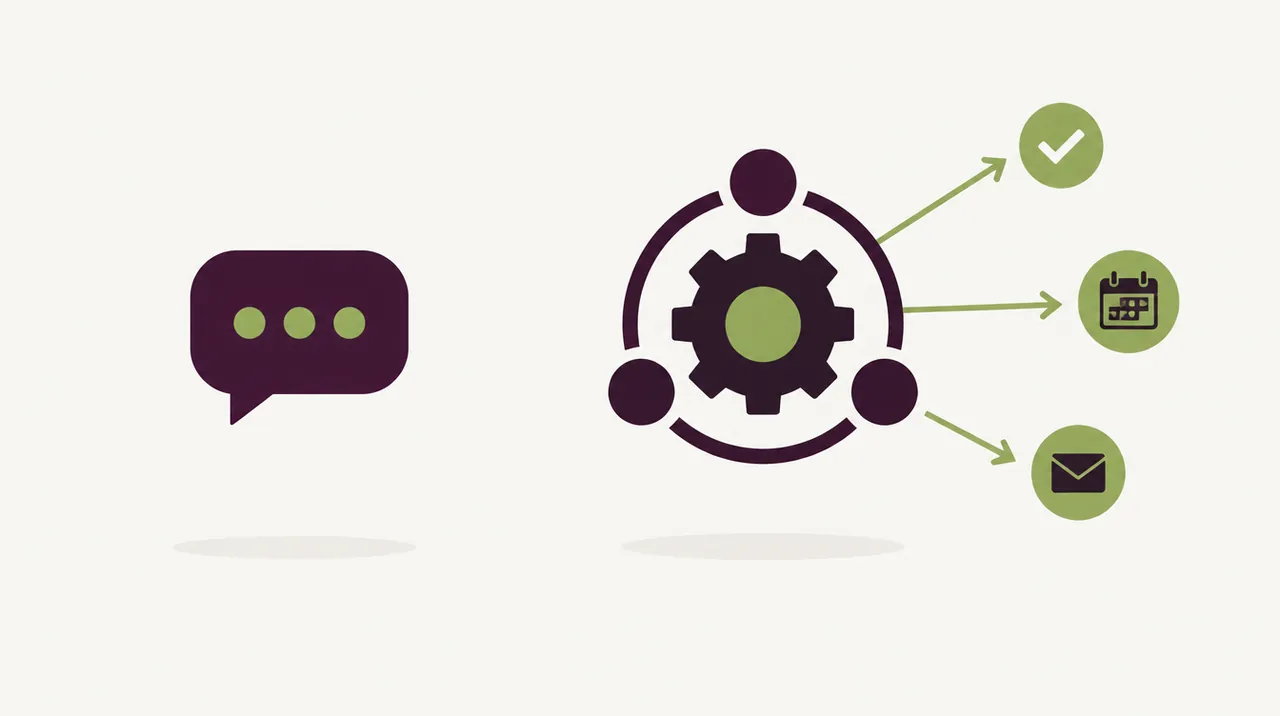
A chatbot answers questions; an AI agent can also act, by genuinely changing data in your systems (booking a slot, updating an order, sending an email). That is the most important difference to remember.
The chatbot: answering fast, within a defined scope
A classic chatbot works from a set of questions and answers prepared in advance, sometimes enhanced by an AI model to phrase the answer more naturally. It excels at repetitive questions: opening hours, product information, the status of a simple order.
Its limit is clear: it cannot act beyond what was planned. If a customer asks to reschedule an appointment, a classic chatbot just points to a form or a phone number, without ever handling the request itself.
The AI agent: understand, decide, and act
An AI agent goes further: it understands a request in natural language, checks the necessary systems (calendar, CRM, order database), and carries out the action itself, within a set of rules you defined in advance. A customer can, for example, ask to reschedule their appointment, and the agent checks availability, proposes a new slot, and updates the calendar without human intervention.
This ability to act fundamentally changes the customer experience: the request is handled immediately, at any hour, without waiting for a team member to be available to make the change.
When a simple chatbot is plenty
Not every business needs an agent capable of acting. If your customer requests mostly concern general information (hours, address, product descriptions), a simple chatbot, cheaper and quicker to set up, answers the need perfectly. There is no point in over-engineering a tool for a request that is, in practice, a simple question.
When an AI agent becomes necessary
Conversely, as soon as your customers regularly ask to change something (an appointment, an order, a booking), a chatbot that only answers quickly becomes frustrating: the customer has to go elsewhere to complete the process, which cancels out part of the benefit. That is the signal that an AI agent, connected to your business tools, adds real value over a simple chatbot.
One point to watch: the agent's decision framework
An AI agent that can act must always operate within a clear set of rules, defined with you upfront: which actions it can take on its own, which require human approval, and how it reacts to an ambiguous or out-of-scope request. This is something we work through systematically during the initial diagnosis of every project, before any development starts.
Frequently asked questions
Does an AI agent necessarily cost more than a chatbot? Generally yes, because it requires connecting and securing access to your business systems, while a simple chatbot stays self-contained. The right choice depends on what your customers actually ask for.
Can a simple chatbot evolve into an AI agent later? Yes, this is actually a common path: start with a chatbot to validate usage, then add action capabilities as the need is confirmed.
Can an AI agent make a mistake while acting on its own? Like any automated system, it can make an error if its rule set is poorly defined. That is why the design phase (which actions to allow, which limits to set) matters as much as the technical development itself.
Torn between a chatbot and an AI agent for your customer relationship? Discover our AI tools in production or book a call to assess what you actually need.