
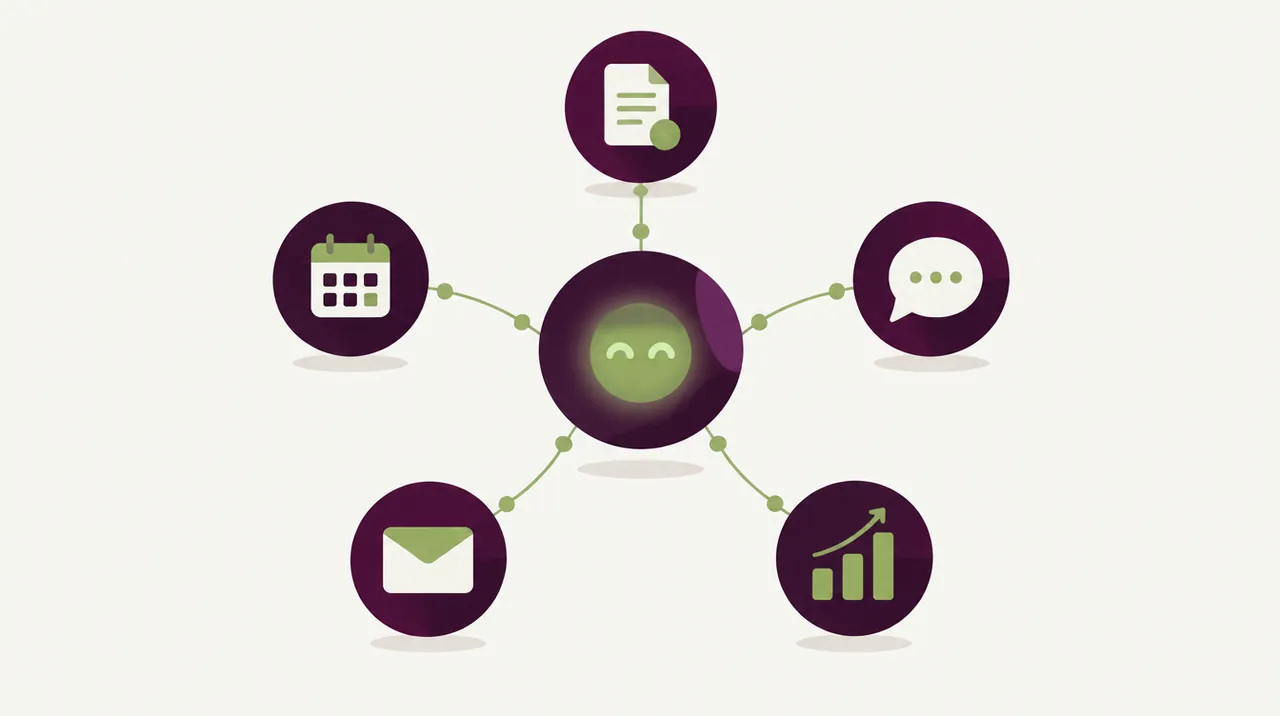
"AI can transform your business": the promise is everywhere, but it stays vague for a small business owner looking for precise examples, not a marketing concept. Here are five real use cases, observed on actual projects, with what they truly change day to day.
The most useful AI in a small business is almost never spectacular: it handles a repetitive task in a few seconds that, added up over a year, represents dozens of hours of work.
1. Processing quotes and invoices without retyping
A quote received by email, a scanned invoice, a purchase order in PDF format: all documents that today need to be read, understood, and manually retyped into accounting software. Document-processing AI automatically extracts the line items, quantities, and amounts, and feeds them directly into the invoicing tool, with human review before validation.
On this kind of process, the gain is not measured in minutes but in reliability: fewer input errors, fewer missed follow-ups, cash flow tracked in real time rather than at month end.
2. Answering customers outside opening hours
A customer who asks a question at 9pm about opening hours, lead times, or product availability does not wait until the next morning: they look elsewhere. A chatbot connected to the catalogue and to the company's real information answers common questions instantly, and forwards anything out of scope to a human.
This is one of the 10 AI tools we have put into production for clients across very different sectors: restaurants, real estate, wine growing. The principle stays the same, only the data changes.
3. Summarising and finding information across a mass of documents
Contracts, meeting notes, email threads: a small business quickly builds up documentation that nobody really reads again. AI can summarise a long document in a few lines, or answer a precise question ("what is the termination clause in this contract?") in seconds, without a team member having to reread everything.
4. Producing marketing content from what you already know
Product sheets, social media posts, replies to customer reviews: this content takes time even though the information already exists inside the company. AI well connected to your catalogue and brand voice generates a coherent first draft, which you adjust rather than writing from a blank page.
5. Automating recurring admin tasks
Staff scheduling, payment follow-ups, appointment booking: these tasks are not intellectually complex, but they interrupt high-value work every hour. An AI agent connected to your calendar and inbox can handle part of this flow autonomously, following the rules you set for it.
These five use cases are not theoretical: they correspond to real projects you can review in our case studies, across sectors ranging from restaurants to real estate to education.
Frequently asked questions
Do you need digital tools already in place to use AI? No, but it speeds up the project. AI needs data to be useful: a CRM, a website, a professional inbox are generally enough as a starting point.
Do these use cases require a large budget? Not necessarily. A simple chatbot connected to a catalogue costs noticeably less than a full website redesign, and often pays for itself within the first few months through time saved.
Where should you start? The simplest path is to start with the task that annoys you most day to day: it is usually the one with the fastest, most visible return on investment.
Do you recognise your business in one of these use cases? Let's talk about your specific situation and what AI could genuinely save you: book a call.