
Imagine this:
You are 37 years old, you weigh 110kg, and your marriage is on the verge of falling apart partly because your partner does not like the fact that you are overweight.
Imagine this:
You are 37 years old, you weigh 110kg, and your marriage is on the verge of falling apart partly because your partner does not like the fact that you are overweight.
What would you do?
You would make an effort to lose weight by going to a gym for an aerobic fitness session. You would push yourself through various exercises with the aim of reaching a healthy weight for your age — and all in the hope of saving your marriage. Right?
Well, that is exactly what Nathalie did not do.
Nathalie had been overweight her whole life and had tried to lose weight many times. But it never worked.
She always failed.
Her husband eventually left. She had to face reality and resolved to do something about her weight. While researching online, she came across a fitness coach's website that gave her hope again.
I can finally do it! she exclaimed.
Yet the fitness coach had not given her any different exercises from those she had already tried. His advice was not revolutionary.
The coach was not a magician making extra kilos disappear either…
The programme was not free.
What convinced Nathalie was related to the weight loss programme itself…
It was full of challenges and tools, accompanied by straightforward advice.
Not only did Nathalie continue the programme for several months (something businesses can only dream of) — she also lost over 50kg and won her challenge.
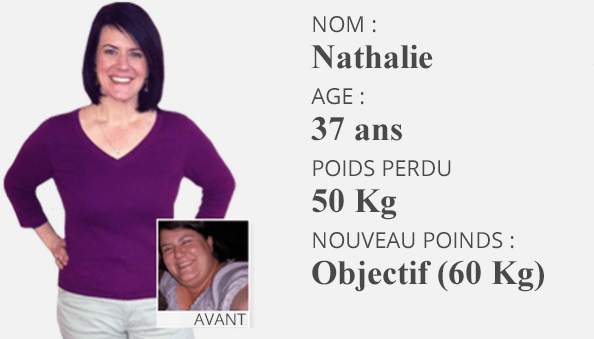
The question is: how did a simple website with simple advice attract Nathalie (and other clients) and give her the desire to succeed at something she had struggled with for decades?
Gamification.
It is simply what helps you not only offer your clients the prospect of an unforgettable experience with your product or service, but also stimulates their loyalty by giving them the impression that you are their one-stop solution.
What is gamification and why does it matter so much?
Gamification is simply the application of elements typical of video games (such as scores, competition with other players, and rules) to other areas of activity, used as an online marketing technique to encourage customers to buy a product or service.
Too complex?
Here is how Wikipedia defines the term (ludification):
"Its aim is to increase the acceptability and use of these applications by drawing on the human predisposition to play."
This does not mean turning your product into a 3D science-fiction game with lightsabres and flying saucers.
According to the same Wikipedia article, gamification can be used in a non-game context. It is built into the delivery of a service or product to give the customer an endless experience. It is not really about creating a game, but about offering an experience that is highly entertaining at the level of play.
Rollings and Adams, in their book "Andrew Rollings and Ernest Adams on Game Design", speak of four game-related actions:
- Play
- Pretend
- Rules
- Goals
I remember the first time I held a smartphone. I became interested in how it worked and also in the animations tied to navigation. I spent a few seconds scrolling up and down the pages just to watch them glide by repeatedly. It was 30 seconds of recreation for me, completely independent of the work I had to do.
But let us take a step back. Does gamification represent a real concept? And why has it become a buzzword in recent years?
Gamification did not appear out of thin air because people were looking to coin a new term. It was born from a fundamental study of human nature and playful tendencies, known as "Flow Theory".
According to a paper written by Jeanne Laine (Flow — The Psychology of Optimal Experience) from VTT Technical Research Centre of Finland,
Flow refers to an optimal experience, a state of mind during which people generally experience deep enjoyment, creativity, and engagement in the activity they are performing.
The paper then lists the conditions that are helpful in creating states of flow:
- Activities are goal-oriented.
- Goals are generally clear.
- Activities are governed by rules.
- There is feedback from actions (generally immediate).
- Activities require skills.
- Activities provide challenges and opportunities for action.
- There is an appropriate balance between skills and challenges.
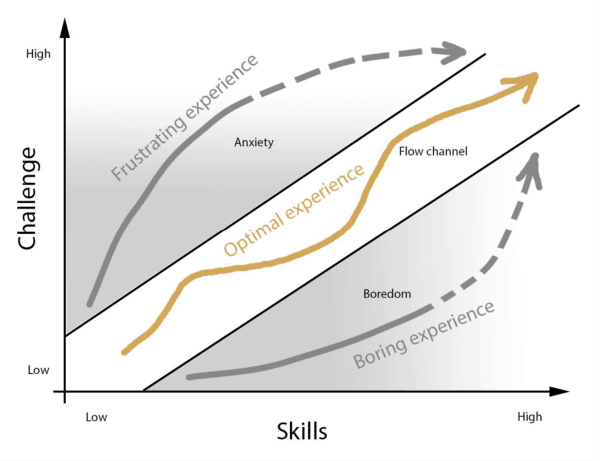
Photo caption: the person is challenged to do their best and can continually improve their skills, including knowledge and understanding.
Image credit: the book "Flow — The Psychology of Optimal Experience."
Despite the influence of customer actions and buyer decisions, the unyielding force of willpower has its limits. Like Nathalie, users want to play and have fun. Humans are naturally drawn to play simply because they want to (do you remember your games of hide-and-seek?).
Buyer behaviour ties our decisions to our ideal self. In other words, given the opportunity, we like to create counter-realities of who we want to be, and then make purchases that bring us closer to that goal.
Food for thought for businesses and UX developers.
The gaming industry has a highly engaged audience. The goal is not to turn products and services into games, but to adapt gaming theories to the platforms through which these products are delivered, while adding value to them.
Just like the product or service itself, the design must also be useful.
Usability expert Jakob Nielsen notes that "usability and utility are equally important and together determine whether something is useful: it matters little that something is easy if it doesn't do what you want."
In other words, does it provide the features you need, and how easy and pleasant are those features to use?
Users are not patient enough to ask: "Please, how do I use this site?" or "Will it be easy to navigate this programme?"
When we encounter such difficulties, our first line of defence is always to find an alternative — as long as alternatives are available to us.
Furthermore, there is growing demand for online learning on a global scale — can it too be "gamified"? Is gamification a concept that can be broadly applied, or is it limited to specific industries? According to the Gartner Gamification 2020 report:
"In the short term, gamification will be used primarily to create more engaging course materials. But by 2020, higher education will be global, with greater equality of access to education and wider recognition of skill levels through badges. Alternatives to formal higher education may develop to make education more engaging, widely accessible, and broadly recognised."
With such an effective concept, it would be a relief if it could be used to encourage audiences to engage with even the most mundane of industries. It is therefore important not to limit its application to only certain types of products (such as websites).
What impact does gamification have on UX?
Why do people in organisations that integrate gamification into their operations have better experiences and how do they offer their products?
Here are a few reasons:
1. People respond positively to fun rather than to obligation.
How do parents get 2-year-olds to eat their vegetables or put on their clothes properly?
They certainly do not force them. Instead of using force, a more persuasive approach is to turn everything into fun — either by chasing them when they run around the house, or by turning the spoonful of broccoli into an aeroplane so it can find its way into their mouths.
The best way to get someone to take action is not to force them to do so, but to make them want to. This is why marketing plays up its features.
Ford Motors had to bring their sales, parts, and service teams up to speed by having them sit certification and training exams.
Naturally, people do not like sitting exams. We sometimes take exams because we have to. So Ford set itself a challenge: they needed to make their training and certification programme more effective, with increased usage, better use of existing resources, and encouragement of both formal and informal learning.
In other words, they needed a larger number of team members to participate fully.
The solution was therefore to switch to "Gamification Mode" and reward the exploration and demonstration of knowledge gained within an online community collaboration.
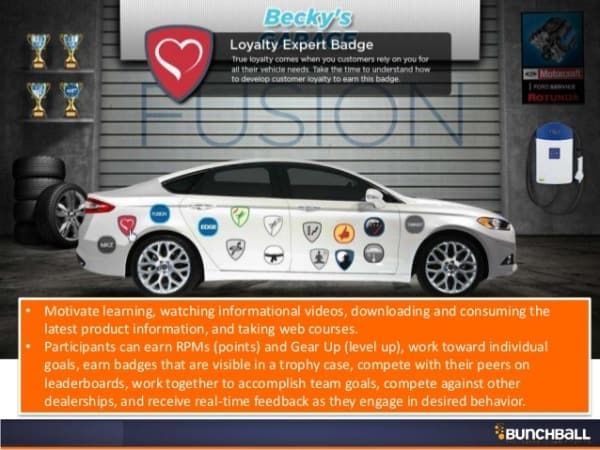
The results?
Participants completed courses beyond what was required to pass their annual certification requirements.
There was a 417% increase in site usage compared with the same period the previous year. And within the first three months, the site surpassed the previous year's entire traffic volume.
Employees and customers need to be motivated to take action. Your job is to motivate them in the most enjoyable way possible.
2. People like feeling that they are making progress towards a final goal.
"Power Up", "Level 3", "50 stars earned".
These terms will not be prominent in games simply because they sound cool. They serve to break down the long-term objective of reaching the final level into small steps so that players do not feel bored and discouraged throughout the game.
They also place different milestones that push people to compare themselves with their peers. Status appears to be the most important incentive and the driving force of social behaviour. Both in their behaviour and in their brains, people place great importance on their status, as highlighted by a study conducted by Caroline Zink of the National Institute of Mental Health (NIMH).
A progress signal leads to a better reputation, which gives us a sense of well-being. That feeling alone represents a reward in itself.
In 2009, Starbucks launched "My Starbucks Rewards", a mobile loyalty app that incorporated a fast payment method and an incentive system to encourage repeat visits. Using the same method as their reward system, Starbucks also introduced virtual badges and points.
How it worked:
Users were rewarded with a gold star every time they paid for a transaction using the mobile app. The first milestone was 5 stars, and once users reached it they were rewarded with "Green Level" status. This status is equivalent to a bonus that allows the user to receive free refills on tea or coffee purchased that day.
"Gold Level" status is reached once a user earns 30 stars within a 12-month period. In addition to benefits and offers, the user could also receive a personalised gold card.
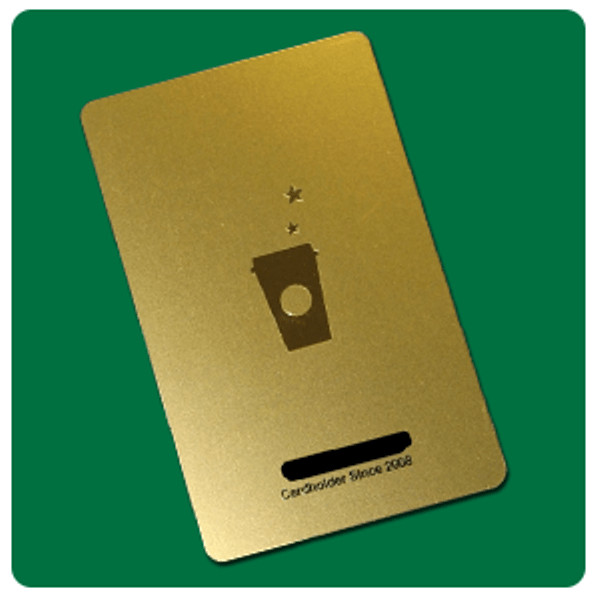
This gave the status an air of exclusivity. It was also the supreme status that people strived to achieve.
What was the result?
Starbucks was able to differentiate their loyalty programme using the app. The mobile app was able to generate more than 6 million transactions per week. It also accounts for 15% of sales in US stores.
The Starbucks app had 10 million users, of whom "50% of Starbucks mobile app users were Gold Level status members", according to Lauren Johnson of Mobile Commerce Daily.
This shows that it was not just a loyalty programme — it was also consistent recognition of status and exclusivity.
3. Given the opportunity, customers want to feel like a Hero.
It is really difficult for an active 2-year-old to watch an episode of Superman and not feel a surge of confidence afterwards.
After all, like children, we have worn capes, put on masks and pulled on gloves and somehow believed we possessed superhuman strength. Some of us even tried jumping off the bed believing we could fly.
This part of being human does not die with childhood. We simply start expressing it in more mature ways as we grow older.
Films like Star Wars, The Lord of the Rings, and even Kick-Ass all follow a particular pattern — a pattern identified as the Monomyth or the Hero's Journey.
This concept was introduced by Joseph Campbell, who describes it as follows:
"A hero ventures forth from the world of common day into a region of supernatural wonder: fabulous forces are there encountered and a decisive victory is won: the hero comes back from this mysterious adventure with the power to bestow boons on his fellow man."
In other words, we decide — guided by a mentor — to act as the hero we want to be. And ultimately, we transform entirely.
Best-selling author Jillian Michaels is a health (fitness) expert and wellness coach with over 20 years of experience. While some fitness programmes rely on participants' self-will and determination with the mantra "you can do it", Jillian went further.
By using challenges, an online community, and a sense of achievement for her students, Jillian was able to help numerous overweight men and women who felt inferior become lean, confident, and bold. They became the heroes they had envisioned in their minds, with Jillian as their mentor.
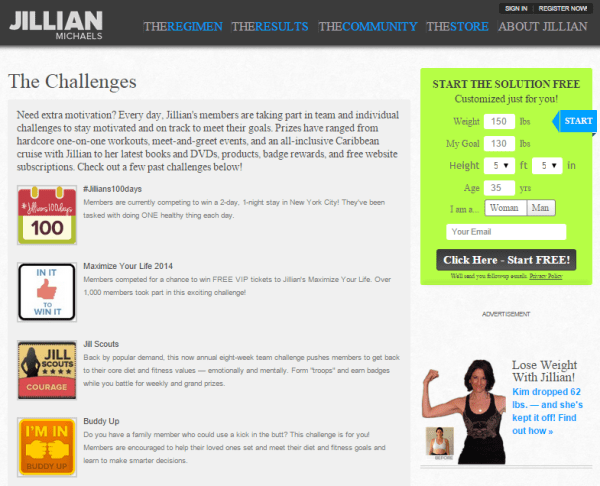
It is no wonder that Nathalie, the 34-year-old woman in our story above, was able to complete Jillian's programme over several months and reach her weight goal by successfully losing 50kg.
By using Jillian's programme, Nathalie was able to go through her hero's journey and emerge as the transformed hero. Having completed Jillian's New Year challenge, she won a one-to-one training session with her mentor.
Through multiple challenges and the tools made available to members, they can monitor their weight loss, food intake, and connect their workouts and dietary plans.
The result?
The objective is to increase paid conversions and lifetime value per customer. By rewarding users through reputation and access to new content and tools, Jillian Michaels.com was able to increase "paid conversions by 5% and customer lifetime value by 20%" according to Olivier Gillin on Slideshare.
Conclusion
It is true that gamification is just one of many ways of illustrating a user experience. But forward-thinking businesses would use even the smallest gaming mechanisms to interact with employees and customers.
However, it is important to bear in mind that user experience is only one piece of the puzzle. The product or service you deliver through that experience must also be of great value. Combine value with a great experience through gamification and you will build a large, loyal following — similar to the 500 million+ "addicts" who cannot stop playing Candy Crush.
Inspired by Why Gamification Impacts UX