
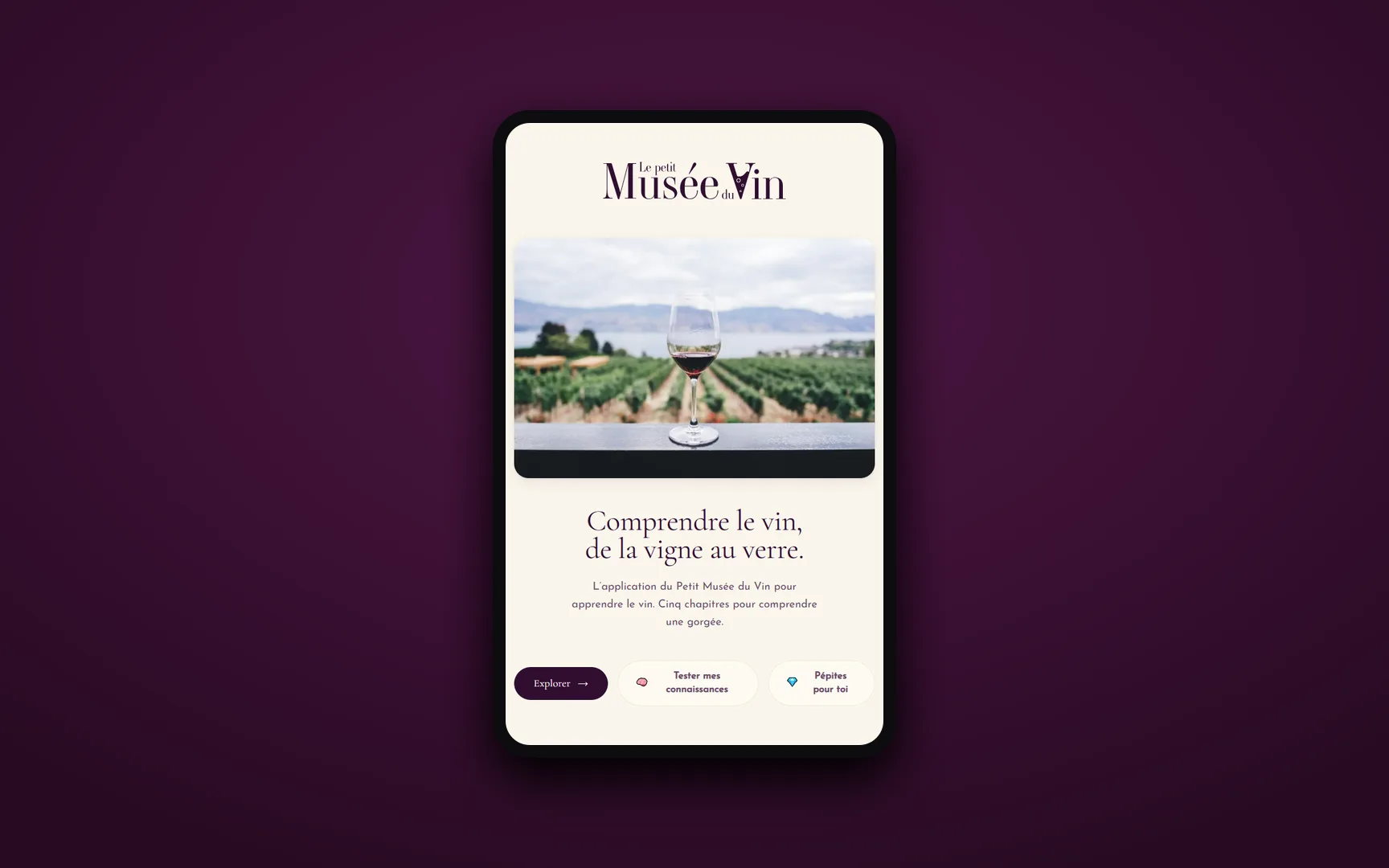
"We don't want a museum with text panels. We want Duolingo." That, in essence, was the brief the Petit Musée du Vin in Lyon gave us. A year on, the visitor data confirms that betting on gamification was the right call. Here's what we learned.
Why gamify a museum?
Gamification isn't a gimmick. In a museum it serves a very concrete business goal: turning a passive visitor into a curious, informed one. And a visitor who understood what they were looking at is a visitor who extends their visit — here, towards the tasting area and the shop.
The museum's reasoning was crystal clear:
Interactive education → informed visitors → tasting → purchase.
Every quiz passed, every mini-game completed brings the visitor closer to the confidence that makes them want to taste, then buy.
Three mechanics that made the difference
Quizzes at every module. Rather than stating facts, we make people guess. The completion rate speaks for itself (more on that below).
The "Spin the Terroir" mini-game. A three-reel slot machine — soil type, climate, vineyard management — generating a different wine profile with each combination. The technical challenge was to make over 300 combinations feel believable rather than random. The solution: a structured outcome system (win, jackpot, loss) with an educational explanation for each spin. Visitors don't play in a vacuum: they understand why a given soil plus climate yields a given wine.
Interactive visualisations. Diagrams where you adjust a parameter and watch the result change in real time. A fermentation process becomes tangible instead of abstract.
What 2,000 visitors taught us
This is where gamification stops being a hunch and becomes a certainty. We instrumented the experience to measure real visitor behaviour over the first month — nearly 2,000 sessions. The takeaways:
- ~3 minutes spent per module on average. Visitors genuinely read and interact; they don't scroll past.
- Up to 12–13 minutes on the most complex modules (fermentation, ageing). Counter-intuitively, the densest topics held attention the longest — because they were presented interactively.
- 97% quiz completion rate. Visitors go all the way through, they don't just skim.
The lesson is clear: it's not the topic that bores people, it's the format. Dense, illustration-rich content holds attention provided it's made interactive.
The good side effect: data to decide with
By measuring engagement, the museum gained far more than a nice figure to show off. It now has a dashboard that tells it which modules to expand, which to rework, and which languages deserve more translation. Decisions are made on real data, not assumptions.
Takeaway
Gamifying isn't adding points to look nice. It's aligning the experience with a goal — here, turning a novice into a curious enthusiast — and giving yourself the means to measure it. The result for Le Petit Musée du Vin: 4.9/5 on Google and visitors who recommend the experience.
More in this series on Le Petit Musée du Vin: