
The events of the past year have had a significant domino effect across the world. The way we work, communicate, and connect with one another has become a burning topic of conversation — and a vital one for web designers as we move forward. New technology trends are influencing how end users navigate the internet and how they interact with digital content.
By staying informed of the latest technological developments, you can better position yourself. In this article, we will explore seven of the key trends that could be useful for your upcoming projects.
1. Artificial Intelligence (AI)
Artificial intelligence (AI) has been on the scene for some time now. However, this technology made significant strides in 2020. It is therefore worth examining what is new and how it can be of use to you.
There is a good chance that many of the latest AI developments — such as automated driving and quantum computing — are not particularly relevant to your web design projects. Fortunately, this technology has also made a fairly significant leap forward in applied natural language processing.
AI systems are now better at picking up on sentiment and intent. Furthermore, they are better placed to imitate human speech and writing, and can even understand images more effectively than before.
This could mean enormous opportunities for you, particularly in the field of chatbots. More advanced language processing capabilities could help these tools direct users to the appropriate channels more quickly — an excellent way to deliver a better overall user experience (UX).
AI data processing has also improved and played an important role in the development of the COVID-19 vaccine. You can implement this technology to collect user data and create more personalised experiences for website visitors, thereby improving their experience and satisfaction with your clients' sites.
Voice interactions are another area where the latest artificial intelligence technology can prove useful. Enhanced language processing could enable more users to step away from the keyboard and begin searching the web by voice. This brings us to our next technology trend.
2. Voice search optimisation
As if search engine optimisation (SEO) were not already involved enough, voice search is now one of the biggest technology trends of the year. Google, Apple, and Amazon all have voice assistants on the market in one form or another, which means that more people have access to this functionality.
The contribution you can make to your web design projects in terms of voice search optimisation will depend on the scope of your services. However, if you work in the industry, it is best to be familiar with the latest SEO standards.
Here are some of the top tips for voice search optimisation:
-
Create question-and-answer-based content. Voice searches tend to use more natural language than text searches. This means that users often frame their queries as questions. Optimising content to answer the most popular queries related to your client's domain could help advance their site in the rankings.
-
Prioritise local SEO. In addition to seeking answers to their main questions, voice search users ask their assistants to help them find restaurants, local services, and so on. Encourage your clients to create and manage their Google My Business profiles and to optimise content for local search. You could make a point of including your clients' addresses in their page footers. You can also offer to design contact pages that include Google Maps integration.
-
Try featured snippets. These are often served up by Google, Siri, and Alexa as the top results. Optimising your content accordingly can help increase your clients' voice search visibility.
If you are not involved in your clients' SEO efforts, you might consider passing this information on to them. Even if you are not the one doing the work, they will likely appreciate you taking the time to offer valuable suggestions.
3. The Internet of Things (IoT)
The Internet of Things (IoT) refers to devices that can "talk to each other" via the web. Fitness trackers and smart lights are two common examples. They share data and require minimal human interaction to do their job, making them well suited to increasing productivity.
Again, language processing and voice search are key elements here. Consider smart home devices, for example. They use voice commands to turn lights on and off, start coffee machines, play music, adjust thermostats, and so on.
In terms of web design, there is not a great deal you can do from a practical standpoint to better integrate the IoT — for now. However, this field is evolving rapidly. We therefore recommend keeping an eye on it and looking for opportunities to incorporate it into your work.
In the meantime, you might consider learning more about designing for very small screens. Smartwatches and other "wearables" are continuing to gain ground. If you are involved in app design for your clients as well as websites, this technology trend could be a useful space in which to develop.
4. Progressive Web Apps (PWA)
Speaking of apps, Progressive Web Apps (PWAs) are another of the key technology trends set to make their mark in 2021. They offer several advantages over native apps, including offline use as well as improved performance and SEO.
If you are looking to expand your services, offering PWA development (particularly for e-commerce sites) could be a profitable venture. There are many low-code and no-code solutions that can help you impress your clients without requiring significant time or effort on your part. AppMySite and AppPresser are two user-friendly tools for WordPress (and Divi):
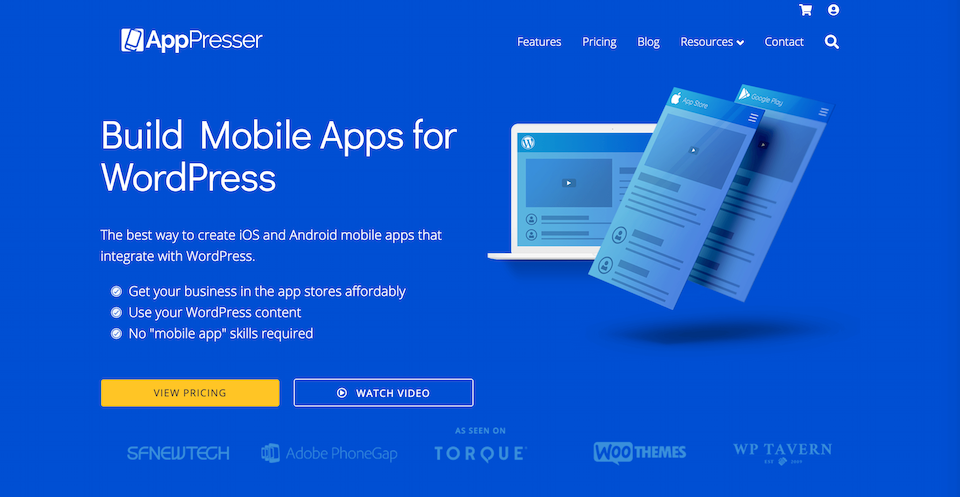
This could be a beneficial technology trend for both you and your clients, as businesses seek ways to connect better with customers in the wake of the pandemic.
5. 5G
The latest advances in mobile internet have had a significant impact on the smartphone browsing experience. With 5G being one of the most important technology trends right now, it also means new opportunities for you as a web designer.
Firstly, reduced latency and improved loading times allow you to incorporate more video into your designs without fear of disrupting the UX on your clients' sites. Video is an engaging, high-conversion medium. Being able to use it more freely in upcoming projects is therefore a huge step forward.
You may even be able to integrate virtual reality (VR) and augmented reality (AR) into your mobile sites now that 5G has arrived. Let us take a closer look at this latter technology.
6. Augmented Reality (AR)
AR technology has an important role to play in the future of e-commerce. More and more people are shopping online as a result of the pandemic, and they are expected to continue doing so even once things return to "normal".
The drawback is that when you do not have a product physically in front of you, you cannot try it on, feel its texture, or experience it to the full. Some companies have implemented AR to help bridge this gap.
Virtual try-on features allow shoppers to upload images of themselves and "see" what they look like wearing a hat or a pair of glasses. IKEA's Place app lets you generate a 3D model of your home and test furniture within it:
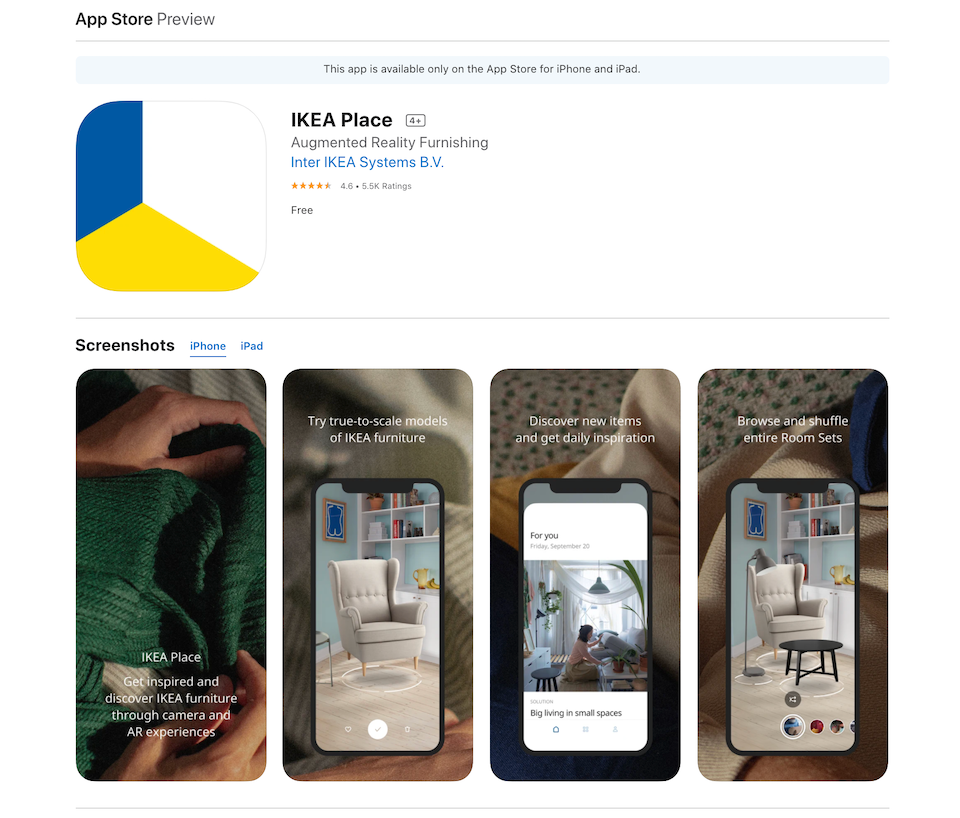
If you design e-commerce sites, learning how to leverage this technology could prove very profitable.
7. Data privacy and security concerns
Data privacy in 2021 is complicated. New uses of digital information — such as contact tracing — are leading some people to relax their concerns about protecting their data online. Companies are also looking for ways to monitor employees working from home. Furthermore, with the boom in online shopping, we are more exposed to targeted advertising.
What does this mean for web design? Well, you will still want to ensure that your clients' privacy policies and cookie consent agreements are visible and up to date. Even as new applications for user data emerge, new data privacy legislation is still expected to come into force.
It is also important to ensure that all your projects meet the latest security standards. With so many people relying on the web to stay connected in both their personal and professional lives, there is more data to exploit — and malicious hackers are well aware of this.
Industry-specific technology trends for web designers to consider in 2021
Before concluding, we want to address certain technology trends specific to particular industries. While they may not be relevant to most of your web design projects, it is advantageous to be aware of them on behalf of your clients and their niches.
First, online learning has become far more widespread over the past year. Not only students, but also workers who — once stuck at home — turned to platforms such as Skillshare to develop their knowledge.
Healthcare is another sector that has recently shifted much of its services online. Doctors want to minimise contact with sick patients and prevent those with mild symptoms from going to surgeries or hospitals where they could catch something more serious. This means telemedicine is on the rise. If you build sites for medical practices, medical groups, or hospitals, they may be looking for ways to integrate their websites with this technology.
Finally, retail and food service businesses have adopted contactless delivery, kerbside collection, and other solutions to minimise human interaction in the wake of COVID-19. You can expect to help your clients implement these options within their online payment processes, so it is important to be prepared.
Conclusion
The key technology trends of this year have been heavily influenced by the events of 2020, in particular the COVID-19 pandemic. Understanding how the digital world has adapted to the recent crisis can help you improve your upcoming web design projects.
In this article, we covered seven rising technology trends, as well as several sector-specific considerations for 2021. Leveraging AI and AR, for example, can help you deliver a better experience to the end user. Voice search is also a rising star in the world of marketing, and it is essential to take into account the changes brought about by 5G and the increased need for data privacy and security.
Freely adapted from English: Elegant Themes
Image by GoodStudio / shutterstock.com