Social media advertising spend is expected to exceed $47.9 billion in 2021. To give you an idea of the scale, that represents nearly 20% of the total advertising spend expected from all businesses across the North American continent this year.
The amount of money spent on paid social media advertising has risen continuously since 2019. And now, most businesses are looking to allocate nearly a fifth of their advertising budget to this type of paid promotion. Social media advertising is unquestionably becoming an essential component of marketing strategies for both small and large businesses alike.
Ultimately, paid social media helps to target audiences and generate sales, just as organic social media does. The advantage of paying for this kind of value? Speed to market, campaign sustainability, and good message frequency.
Organic social media traffic can take days to build because of the algorithms working behind the scenes. If you are running a short campaign, this ramp-up time can cost you visibility and prospects. With paid social media, your campaign can launch with an extra boost in terms of speed that organic posts simply cannot provide. In addition to maintaining views, traffic, and engagement for as long as your credit card is valid, you will have the advantage of "retargeting" consumers with your adverts to achieve an ad frequency that you can control.
In this article, we will look at what paid social media is, the components of such a strategy, and the main platforms for running paid adverts.
What is paid social media?
Paid social media advertising is a method of displaying sponsored marketing content or messages on popular social media platforms, targeting a specific sub-audience.
Pay-per-click advertising, brand- or influencer-generated content, and display advertising are all examples of what is possible on social media. You encounter paid social media advertising when you see a post tagged as "sponsored", "boosted" or "promoted".
Each channel is different. Twitter offers short-form content, Instagram focuses heavily on visual content, Facebook has its own marketplace for shopping enthusiasts, and LinkedIn is the home of networking professionals.
As such, paid adverts on each platform differ, notably depending on the campaign and the audience.
Here, we will explore a few quick strategies to help you decide how to use paid social media features to your brand's advantage.
Paid social media strategy
A good paid advertising strategy leverages external marketing activities on social media that support targeted advertising. It involves using these channels' native advertising tools to create, schedule, and publish targeted adverts that will reach a specific market. The objectives of such a strategy may include awareness, consideration, or conversions.
Using social media advertising allows you to make the most of a marketing budget that might not be large enough to promote your brand through traditional media channels. If your business is working with a limited budget to achieve high ROI targets, look no further. We have gathered the key information you need to know about using paid social media advertising.
To create a paid social media strategy, you will start with two essential elements: an objective and a budget.
Strategy objective
Defining your strategy's objective gives your subsequent tactics a direction to follow and a goal to reach. Think of this strategy as a road trip. You start your journey at home with the aim of reaching your destination at a certain time. Paid social adverts work in the same way — your audience begins their journey with your brand on their news feed and your objective is to drive them towards the destination: a content offer on your website, an email subscription form, or even your social network profile itself.
To determine where the journey begins, you will use filters, parameters, and other criteria to narrow your audience so that everyone you target is starting from a similar place. This does not have to be a physical location (though it can be). You can target people based on their age, hobbies, and even their profession.
Once you have your starting point, it is time to define your destination. Different social media advertising platforms have their own conversion tools, but the ultimate objective is almost always the same: getting people to share their contact details with your business. You can do this via a form or by inviting them to visit a landing page on your website. Both work to reach the destination, but depending on your business's needs, you may prefer one over the other.
Strategy budget
Paid social media advertising is one of the least expensive types of advertising available on both the traditional and digital markets. The pay-to-play model of these channels makes them flexible enough to target only the people your business wants to attract. As a result, you only pay for those you are actually able to reach.
Unlike television or radio adverts, which are priced based on the length of the spot and the duration of the broadcast, social media adverts are priced according to the length of the campaign and the potential number of impressions your adverts will generate. This gives these types of ads a far more favourable KPI to track — cost per acquisition — compared with traditional ads, which can only vaguely track cost per million impressions.

The cost of paid social media advertising can start as low as €1, due to the bidding model and lottery system some platforms use to distribute ads in news feeds. Spending on this type of advertising is practically unlimited, but you can set a cap that will prevent the campaign from spending more than you have authorised.
You will need to monitor your credit card balance when you approach the spending limit you have set, as these campaigns are programmed to stop running when the funds run out. This might sound helpful, but it can be at best annoying and at worst damaging to your campaign. If you are running a large campaign that requires a budget exceeding your credit card limit, even a few hours of downtime to pay the balance can result in a loss of prospects and momentum for your campaign.
To avoid this problem, consider increasing the balance on your business credit card so you have enough time to pay it off before the adverts max it out, or try setting a lower daily spending limit for your campaign.
Platforms for paid social media
Each paid social media platform has unique features that set it apart from its competitors. However, there are three key characteristics of a converting paid advert that you will want your chosen platform to support: visual content, easy access to lead capture forms, and enough space to display a compelling advert.
When advertising on Facebook, it pays to use targeting. It is by far the most robust advertising platform available, and for good reason. This feature operates on a bidding system — a type of ad buying process in which advertisers bid for a number of ad placements based on their preferred target audience. That bid is then entered into a lottery for a chance to be selected and shown to that audience. Facebook ads can narrow an audience down to just a few hundred people based on geography, interests, demographics, and more. And while this may not be beneficial for most large businesses, it can make all the difference for a small one.
Beyond the lottery, Facebook ads allow you to serve adverts to your customers based on their behaviour. This is useful because you can continue to advertise to your existing Facebook customers based on what Facebook tells you about how they use the app.
Using Facebook Ads helps you generate new leads and build brand awareness. Facebook provides excellent reports and analytics for experimenting with variables such as posting time and content type, so try using different ad formats and see what your audience engages with most.
Facebook ad example: Network for Good
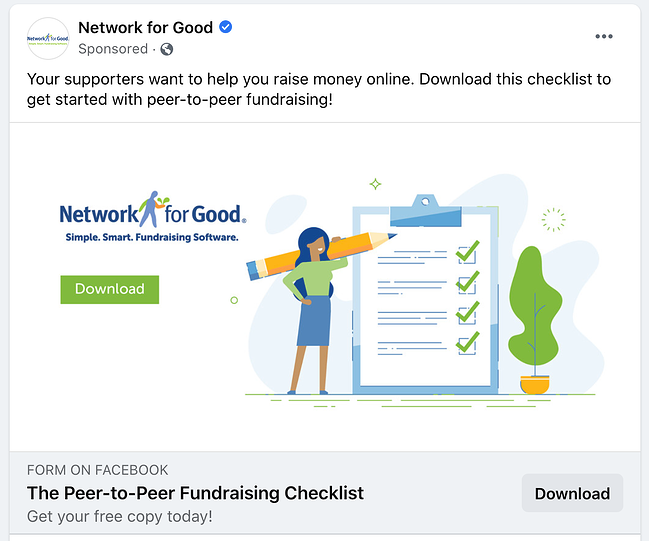
Network for Good has had a solid advertising strategy for a number of years. Here is why this ad works:
- It keeps users on the platform. When a user clicks to download the proposed checklist, they are not redirected to an external website. Facebook gives businesses the option of filling in forms within the app (which is a way of saying that users stay on Facebook while they convert on the ad). This means the user experiences minimal disruption when interacting with the ad and can resume their Facebook session as soon as they have finished downloading the checklist.
- There is a clear incentive to convert. There is no ambiguity about what this ad wants me to do — download the data collection checklist. Simple, clear copy like this makes it easy for the user to convert on the ad, as they don't have to think about what to do next. They can either keep scrolling or download it.
As a consumer, paid adverts on Twitter tend to take me by surprise. I barely notice I'm looking at a sponsored tweet because it looks just like ordinary tweets. As a marketer, that is excellent news — it means more eyes on your adverts, because they are not as conspicuous as adverts on other social channels.
Why Twitter ads? Well, Twitter reports having 192 million monetisable daily active users (the number of people who can see your advert on any given day), and when you use their advertising software, you can target your ad at a specific demographic.
Twitter ad example: The Penny Hoarder
As a native of Tennessee, The Penny Hoarder can infer that I might like to see images and copy referencing my home state. Geographically targeted ads can be effective for businesses that fall into a broad market category, like The Penny Hoarder. Financial advice applies to anyone anywhere, but by framing content in a way that relates to my life, I felt compelled to click the ad and find out more. Here is why this ad works:
- It drives more traffic to this blog post. The original article was published in August 2020, but continuous advertising on Twitter brings more views than it could ever receive organically. Unlike Facebook, which has designed ways to keep people on the platform longer, Twitter allows users to visit the Penny Hoarder website and read the article in a single click.
- It is visually compelling. Geography is just one way to evoke emotions and make them resonate with consumers in an advert. By framing this ad (and the article it promotes) with an identifier like Tennessee, people who live in the area or are from there will instantly think: "This has something to do with me and my community — I should pay attention."
Twitter provides ad settings based on your budget, such as how often it will be seen, where it will be seen, and what type of ad to run. When you are ready to run your social ads on this platform, Twitter offers you different formats to choose from based on your objectives.
84% of people discover new products on Instagram — up from 64% just four years ago. With growth like that, paying for a little visibility in front of the platform's 1.16 billion accounts in ad reach is probably not a bad idea.
To run adverts on Instagram, you will need a business profile — this allows you to set up an e-commerce shop directly in the app. (A bonus if you do not have a website ready to accept payments, or if you are testing online commerce for the first time.)
Since Facebook owns Instagram, you will be running adverts on both platforms simultaneously, and they can all be managed through Facebook.
With Instagram ads, you can choose a suitable advertising spend starting from €1. This amount is tied to the campaign timeline and the size of your audience.
I compare Instagram ads to filling a petrol tank — you get the amount of fuel you pay for. On Instagram, your ad campaign runs for the length of time you pay for.
Instagram ad example: Aveeno
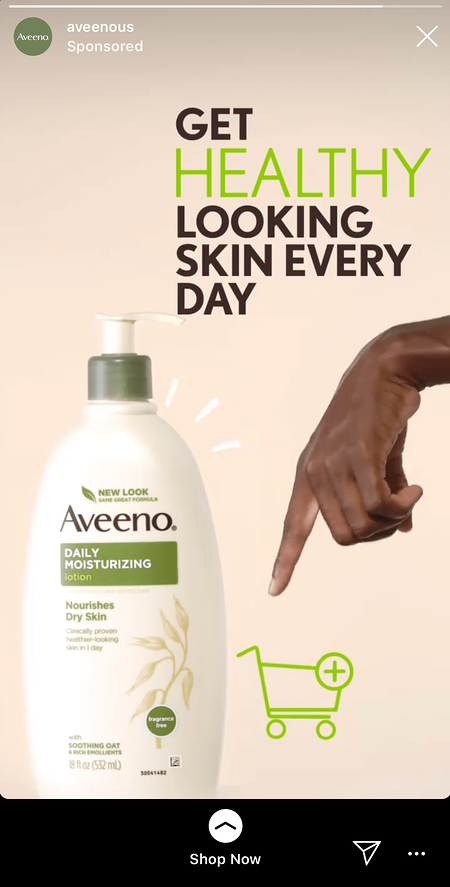
Aveeno used Instagram's advertising platform to target consumers with their product. The simple design draws the eye without becoming overwhelming or distracting. Here is why it works:
- It is visually appealing. The neutral colours and clean design draw our eyes to the product. (The pointing hand is a bonus that directs attention to the CTA — the shopping basket!)
- The call to action is simple. One of the handy features of Instagram ads is the ability to swipe up to find out more about the product or make a purchase. When you are done, it is easy to close the Aveeno website and continue consuming other Instagram content.
On LinkedIn, millions of professionals have found countless professional connections, their dream job, or both. The platform allows you to reach thousands of people in your sector, including thought leaders, hiring managers, and decision-makers.
Fortunately, as a marketer, LinkedIn's paid adverts allow you to reach these very same people on behalf of your business.
There are 740 million professionals on LinkedIn, and four out of five make business decisions, such as purchases. This is a B2B advertiser's dream come true. With the potential to reach 60 million decision-makers on the most popular social platform for lead generation, it is worth considering LinkedIn as an optimal platform for B2B advertising.
LinkedIn's targeted adverts allow you to enter keywords and select audiences by category. So if you are posting a job for a particular position, LinkedIn can help you find a diverse pool of candidates with relevant experience.
LinkedIn ad example: ON24
ON24 uses a short, simple sentence to open a dialogue with its target audience. By focusing on the business use cases for its product, ON24 can position itself as a thought leader on the subject of buyer journeys, encouraging LinkedIn users to register for the event. Here is why it works:
- It keeps users on the platform. Similarly to Facebook, LinkedIn uses in-app form fills to facilitate the exchange between businesses and LinkedIn users registering for the event. This way, once they have completed their registration, they can continue searching for their next opportunity, networking, or engaging with other content creators.
- There is an invitation to continue the conversation. Regardless of how much you spend on adverts, there is no way to buy engagement on them. Comments, likes, and shares must always come organically, which means the captions, previews, and headlines you choose for your adverts must make the most of the limited space available. ON24 does an excellent job of posing a question that everyone has an opinion on or something to contribute in the caption.
You can also experiment with ad formats on LinkedIn to find the one that is most effective.
Growing your paid social media strategy
When you invest in a campaign, no matter the amount, you will want a sustainable return on investment that shows the budget, effort, and resources you spent were worthwhile. This ROI growth means you will be able to scale your campaigns in the future, and paid advertising can fuel your success.
Now that you have a solid understanding of the most popular paid social media advertising platforms on the market, you should be scrutinising all the hard work put in to deliver that return on investment. The native platforms we mentioned earlier offer reporting and analytics, but be careful not to get lost in them if you need to manage several at once — it can quickly become complicated.
Investing in social media: the verdict is in
It is easy to assume that advertising spend is reserved for big brands, but making informed purchasing decisions ultimately benefits ALL businesses.
The truth is that social media makes advertising accessible to both large and small businesses. Once you have learnt how to plan, create, and position your adverts in front of your target audience, you will find it far easier to prove the ROI of your advertising campaign to your stakeholders.
Freely adapted from English: HubSpot