
In 2016, a study was conducted on consumer behaviour in relation to reviews and comments posted online about local businesses.
The aim was to analyse how users read and use these reviews. Understanding the key trends in this area is of considerable importance for any local retailer.
As we shall see, this highlights the power of impact these reviews carry. Taking them into account is therefore not optional in an effective communication strategy.
Key takeaways

Before examining this study in detail, let us cut straight to the essentials by summarising the key trends that are sure to matter to any retailer.
84% of internet users trust online reviews as much as personal recommendations from people they know.
5 out of 7 consumers will leave an online comment if asked to do so.
90% of consumers read fewer than 10 reviews before forming an opinion about a business.
54% of internet users will visit a business's official website after reading positive reviews about it.
73% of consumers believe a review is no longer current or relevant if it is more than 3 months old.
74% of consumers say that positive online reviews increase their trust in a business.
58% of consumers say that star ratings are important.
About this consumer study
This study on consumers of local businesses (Local Consumer Review Survey) was first conducted in 2010. Since then, the study has been repeated every year. And it is clear that the impact of online searches and reviews on purchasing decision-making has grown considerably over the past few years.
Some questions in the study have changed over the years.
For the most part, however, it is possible to compare the results with those from 2015 or 2010.
This study was conducted in September 2016 and is based on a panel of 1,062 individuals who responded to the questions.
Why online reviews matter so much

It comes as no surprise: a positive online reputation is the most powerful marketing tool available for convincing new users.
Customer comments and star ratings help consumers shorten their research time and make decisions more quickly — with greater confidence.
Indeed, what advertisement could be more persuasive to a prospect than the sincere words of a satisfied customer? However effective they may be, a business's own communication tools cannot compete with reviews left by its customers.
These comments and ratings are free from commercial stakes; the users who write them have nothing to gain or lose by being dishonest about their experience. This gives them a credibility regarding products and services in the eyes of other users.
Of course, one can always lie, invent comments, or attempt to remove negative reviews. But all of this, in addition to being dishonest, would be futile.
A fake review is quickly spotted, and the internet is not controllable. Deleting a dissatisfied consumer's review is to expose yourself to their anger. And, like a snowball effect, risk an even more negative comment than the previous one, which will prompt others from internet users scandalised by this attempted removal.
Moreover, a negative review also has its positive sides. Not that they are desirable, but they do in a sense prove the honesty of the page on which they appear. A page that only features praise for a brand quickly appears suspicious to internet users. Whereas a few negative reviews prove the honesty of both the negative reviews and all the positive comments on the same page.
The study questions
"How many times have you used the internet to search for/find a local business in the last 12 months?"
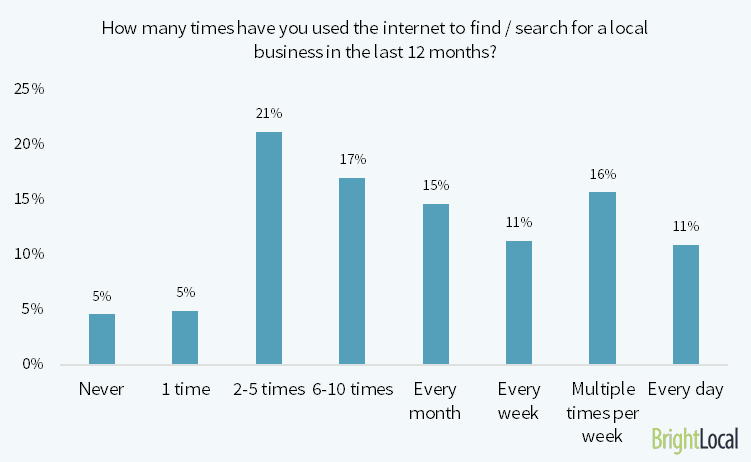
To this question, 53% of consumers answer "at least once a month", compared with 43% in 2015.
Furthermore, 5% say they have never searched for local businesses online. The figure was 9% the previous year.
"Where do you find reviews from other consumers?"
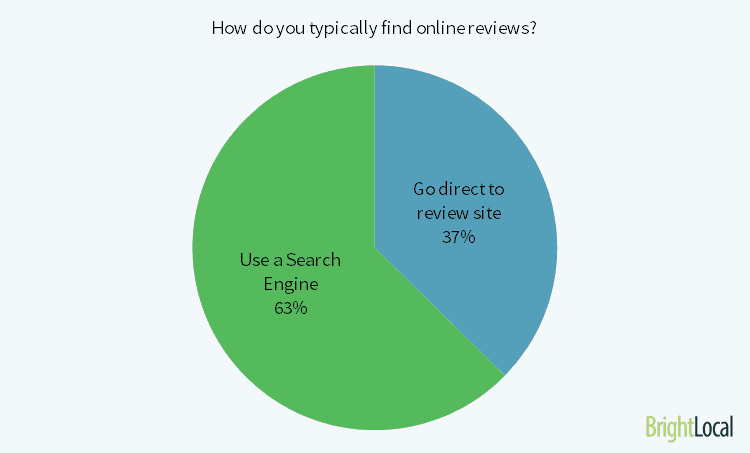
This question is new to this study. It is therefore not possible to compare results with the previous year.
However, we can note that 63% of respondents use a search engine (Google, Yahoo, etc.) to obtain reviews and ratings for a business. Compared with 37% who go directly to a specialist ratings site (Tripadvisor, Foursquare, etc.).
This highlights the importance of the relevant websites and search engines. It is therefore far preferable to target both rather than restrict yourself to a guest book on your own website.
"For which sectors do you search for online reviews?"
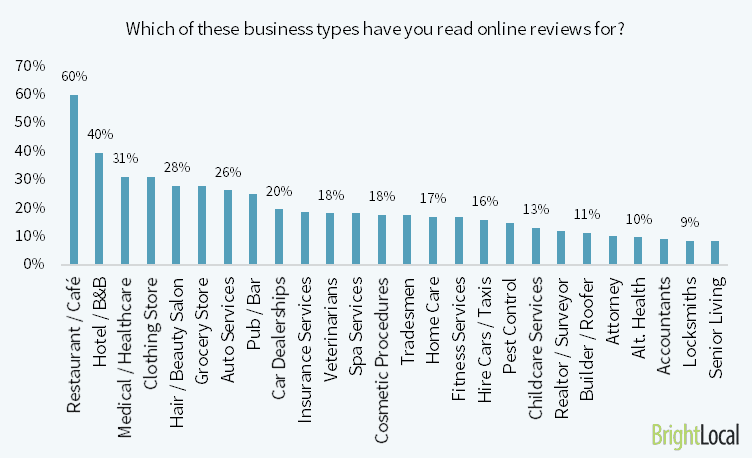
Here, restaurants and cafés come top, with 60% of respondents having read online reviews for this sector.
Behind them, hotels and bed & breakfasts with 40%.
Also popular: medical, clothing shops, grocery stores, and car repairs with 31% to 26%.
However, we can put this into perspective by noting that the more frequently a sector is used by consumers in their daily lives, the more likely it is to have reviews and readers of reviews.
Thus, the average consumer uses restaurant services more often than locksmith or legal services. It is therefore logical that the restaurant sector appears far ahead of the latter in the study results.
This does not prevent users from consulting online reviews for locksmiths. The phenomenon is simply less visible because the need for a locksmith is itself less frequent.
"How many online reviews do you read before you feel you can trust a business?"
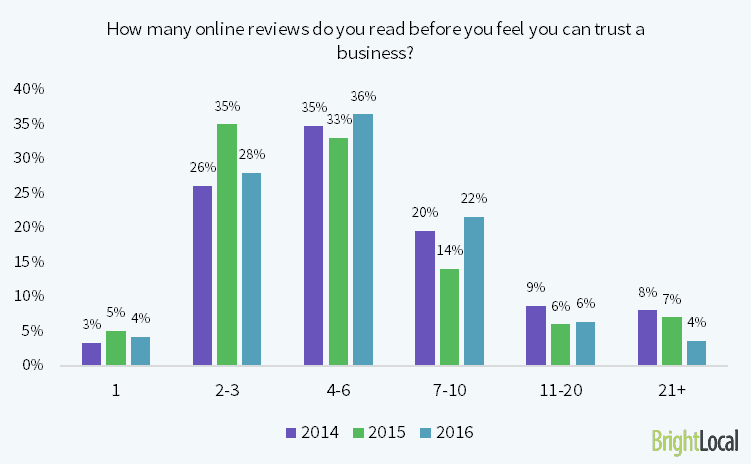
90% of consumers read fewer than 10 reviews before feeling confident about a brand.
68% form an opinion by reading just 1 to 6 online reviews.
Only 10% take the time to search for and read more than 10 reviews (compared with 13% in 2015).
Consumers therefore form their own opinions faster than ever before.
To remain appealing in the eyes of these consumers, a solid web communication strategy must allow you to monitor reviews and, where possible, obtain positive ones.
This is where a brand's web reputation can be won or lost. The aim is to avoid, as much as possible, having the first 10 reviews an internet user reads being negative. This would significantly affect their view of the brand concerned and could prevent them from continuing their research — even if the rest of the comments, beyond the top 10, are positive.
It is therefore important to encourage your satisfied customers to leave their review (without ever forcing them or falsifying their feedback, needless to say) so that any possible negative reviews are pushed further down the list.
Several retailers prefer to ignore this aspect of their communications or feel it is unimportant. The fact is, however, that customers will leave reviews about your business whether you like it or not. It is therefore better to be proactive on this matter rather than reactive. It is worth knowing that this can represent an opportunity to get in contact with consumers and receive honest feedback.
Simply asking a customer who seems satisfied if they can leave an online review costs only a few seconds. And the biggest risk is simply that they do not do it.
"What elements in a review do you pay the most attention to?"
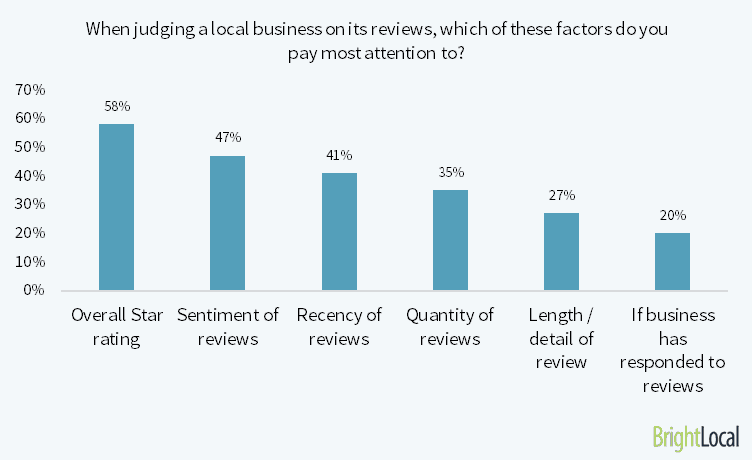
58% of respondents pay most attention to the star rating.
In second place comes the general sentiment of a review, for 47% of respondents.
Finally, equally important: the recency of the review for 41% of the panel.
The star rating is without doubt the most important due to its visibility. It is the first thing a user sees when they arrive on a site that uses this system. The visual aspect is generally more engaging than text. It is also something that can be understood in any language, giving these stars a universal quality.
They distil the quality of a business and its reputation into an easy-to-understand image and an easy-to-compare score.
However, two other criteria must be considered alongside these stars: the general sentiment of a written comment, and its recency.
For example, a 5-star rating with glowing reviews dating back 3 years will probably not be taken into account by internet users. Or at least, the age of this rating will make it less reliable in their eyes: in 3 years, things may have changed significantly in a business, for better or for worse.
Furthermore — and this may come as a surprise — quantity of reviews comes only in fourth place in terms of the importance internet users attach to them. Indeed, one often hears that the more online reviews a business has, the better it is for them. The present study shows, on the contrary, that the overall sentiment and recency of reviews trump their quantity.
Finally, 9% of respondents say it is important for a business to respond to comments left about it. Although the score is relatively low, it nonetheless shows a certain level of interest among consumers for businesses that take the time to reply to them. While not the most critical factor, it is a simple step to implement that could earn you points and set you apart from the competition.
"What is the minimum star rating required for you to trust a business?"
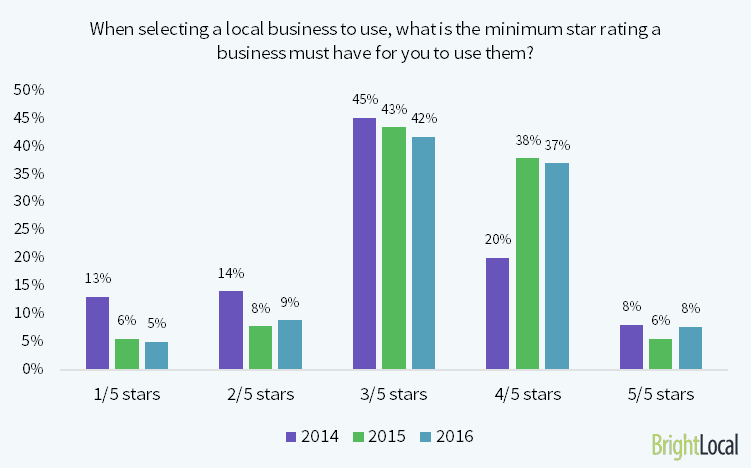
87% of respondents say a business must have 3 to 5 stars for them to use its services or products.
Only 14% of them would consider using the services/products of a business with 1 to 2 stars.
Consumers are therefore not looking for perfection at any price, but for a business they can trust.
Consumers view the star rating as a critical element in their consumer behaviour. As such, 45% would not use a business with fewer than 3 stars, considering the quality too low.
But from 4 stars upwards, only 8% do not consider the quality sufficient. Most people are perfectly aware that no business can be perfect and that dissatisfied customers can exist even for a high-quality establishment.
"For a local business, how recent does a review need to be to influence your consumer behaviour?"
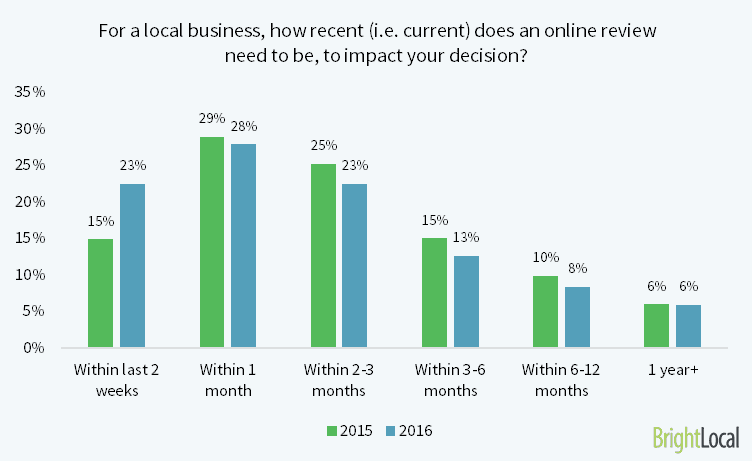
73% of respondents consider that a review older than 3 months is no longer relevant.
22% only take into consideration reviews from the last 2 weeks.
Consequently, having recent positive reviews is important for a local business. Consumers want to see up-to-date reviews that reflect current services and products, not those from 2 months or a year ago.
Reviews more than a year old will therefore have only a limited impact on their opinions and decisions compared with reviews from the past week or month.
However, this should be put into perspective according to the sector concerned. A restaurant should have regular reviews given the high volume of daily customers. Conversely, an accountant can afford a longer gap between reviews, given their less frequently sought-after offering — or one that is mainly in demand during certain periods, such as tax season.
Moreover, some businesses change and evolve faster than others. Again, restaurants or hotels with high staff turnover mean the quality of their service can often vary with the comings and goings of employees.
An accountant or dry cleaner, on the other hand, are less volatile in this respect. Older reviews therefore remain relevant to the quality of their services.
"How do online reviews impact your opinion of a local business?"
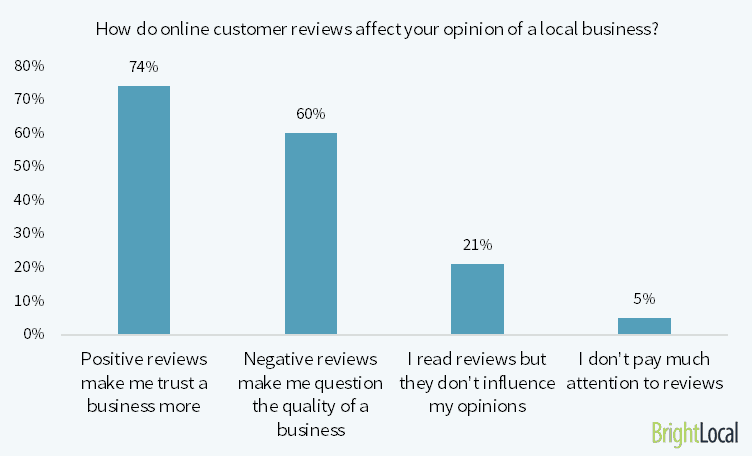
74% of respondents say they trust a local business after reading positive reviews about it.
60% say negative reviews put them off using the local business in question.
Only 5% say they do not pay attention to reviews (compared with 11% in 2015).
Nothing surprising here: positive reviews give a good image of a brand, while negative reviews slow down, or even halt, any desire to buy.
21% of respondents read online reviews but say they are not influenced by them in their opinions. This could be explained by a mistrust of online comments (fake reviews, for example).
"How do online reviews impact your purchasing decision regarding a local business?"
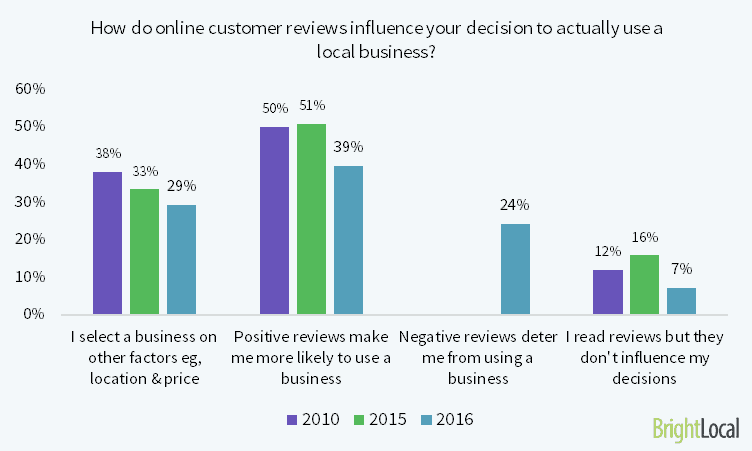
39% of respondents say a positive online review makes them more likely to use the local business concerned.
29% choose their local service provider for other reasons.
24% say negative reviews discourage them from using the local business in question.
This demonstrates the genuine importance of reviews in consumer choices.
"When you read positive reviews about a business, what is generally your next step?"
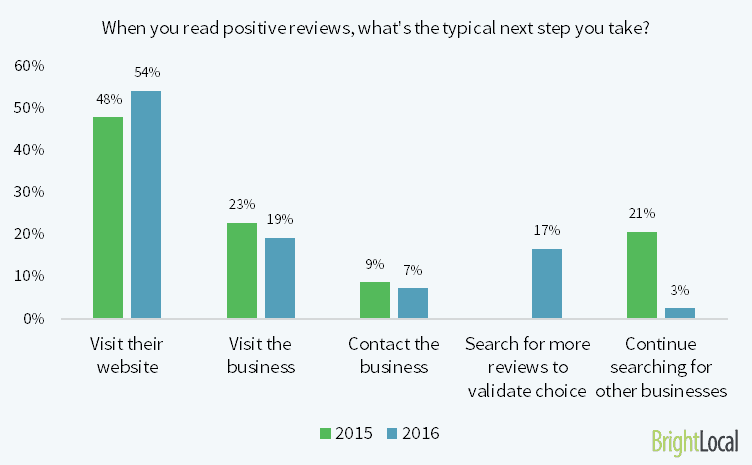
54% of respondents will visit a business's website after reading positive reviews about it (compared with 48% in 2015).
19% will visit the business in person directly (compared with 23% the previous year).
17% will continue searching for reviews (a new response option compared with previous years).
It comes as no surprise that the majority of consumers visit a brand's website after reading reviews about it. Review sites often provide a direct link to the websites of the businesses reviewed. The importance of having an online presence through a website is therefore all the greater.
Regarding the 19% who go directly to the business, this obviously depends on the type of business in question. While this trend will be stronger for a restaurant or a shop, it will probably be weaker for a wedding caterer.
However, the main trend clearly shows that the step following the reading of reviews is a visit to the website before making contact or visiting the shop. From this perspective, a "Contact" section is all the more important on a retail website.
"Among these sectors, for which ones is reputation most important in your purchasing decisions? (3 answers possible)"
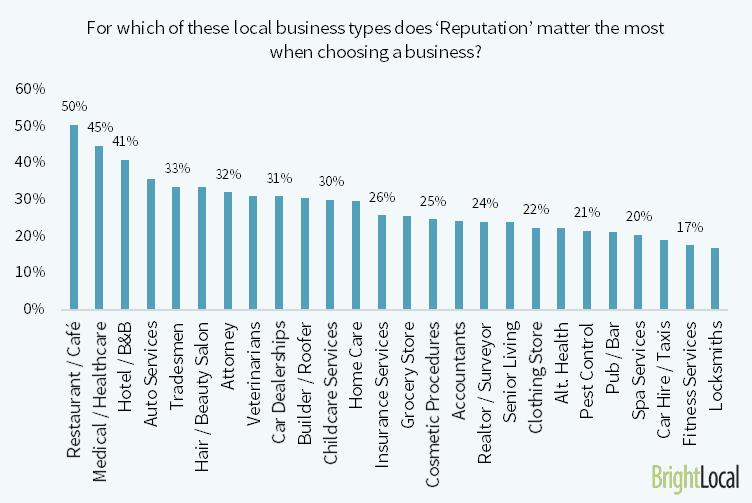
Once again, restaurants and cafés come top, with 50% of responses. Followed by the medical sector with 45% and hotels with 41%.
For any type of business, having a good online reputation is inevitably important.
"Has a local business ever asked you to leave an online review?"
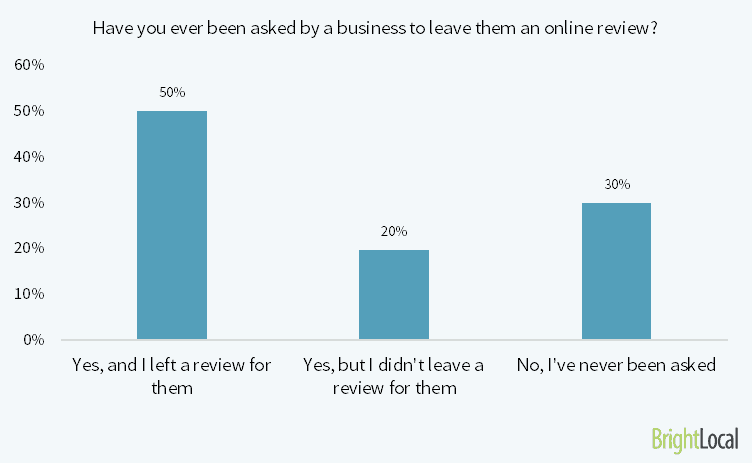
50% of respondents say they have been explicitly asked to leave an online review and did indeed do so.
20% received the same request but did not leave an online review.
30% say they have never received this type of request.
This shows that 5 out of 7 consumers will leave an online review if asked.
It is therefore important — and straightforward — to ask a customer to leave a review.
However, this must be done carefully. And it is better to do it regularly rather than on a single short period. Why? Because rating sites, for the most part, may find a sudden surge of reviews for a business suspicious. As a result, some — or even all — of the comments posted may be removed. This is particularly true for a business that had no reviews posted before this wave of comments.
Therefore ask for reviews consistently over time, and from a few customers at a time.
Furthermore, it goes without saying that you must not buy online reviews. Equally, you must never make a consumer feel they MUST leave a positive review.
"In the last 12 months, have you left a review/recommended a local business to people you know by one of the following methods: word of mouth, Facebook, Twitter, Yelp, TripAdvisor, Google, other review sites, or the business's official website?"
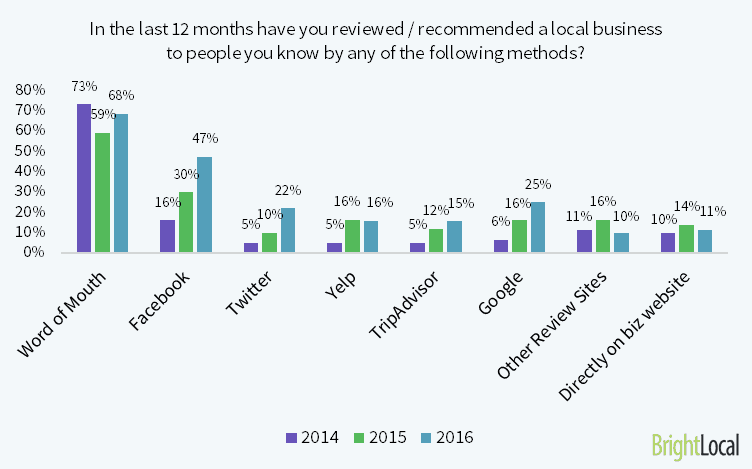
Word of mouth remains the most popular method, accounting for 68% of responses.
47% of consumers have recommended a local brand on Facebook (compared with just 17% the previous year).
Google accounts for 25% of responses, compared with 16% the year before.
Twitter, meanwhile, represents 22% of respondents, compared with 10% in 2015.
For more details, you can find the full consumer study here (in English only).