
SEO tips and advice
While there is no magic recipe for appearing on Google's first page (for organic search), a number of best practices allow you to respect search engine algorithms as effectively as possible. Below is a non-exhaustive list that aims only to serve as an introduction to the complex discipline that is SEO (with a capital S, if you please).
> Jump directly to the list of dos and don'ts by clicking here
Understanding how search engines work
Robots are sent to the HTML pages of your site to extract, analyse, and classify its content. This content is returned when an internet user conducts a query, based on the relevance of the page and according to specific criteria. Everything counts: the text, images, videos, the page URL, the title, the hierarchy of the page's content, links pointing to the page, the words contained in those links, the origin site of the link, and more. The stronger the concordance between all these elements, the more a search engine will classify the page as coherent in relation to a search.
Organising your website is already optimising it
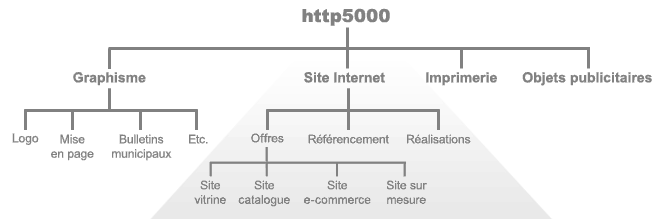
The most important thing, and what gives your site its value, is its content. An old, unattractive site with coherent content will in all likelihood be better positioned than a beautifully designed site with nothing in it. You must therefore start by organising content around broad themes, then sub-categories. For example, http5000 works across various fields. The main menu reflects these broad domains (graphic design, website creation, printing, promotional items), then is divided into sub-categories (the offers (showcase site/e-commerce site/bespoke site, etc.), SEO…). This classification gives the architecture of your site. It is an important step that combines the demands of SEO with the ergonomic and intuitive needs of the site.
Write or have written…
Once the skeleton of the site is defined, it needs to be dressed, filled out, and completed! For this, there is no shortcut: you need to write. It is essential that the content is original — copy-paste is now immediately detectable and penalised by search engines. They will not take into account a page or part of a page that has been copied if they find the original already exists. You must therefore express your information yourself, introduce yourself, or get help to do so. http5000 offers you a web copywriting service made up of journalists who can write fluently on a variety of subjects and who understand the requirements of the web. What are those?
The domain name
This may seem obvious but it is worth stating: the first criterion taken into account by search engines is the site's name. tyre-gerard.co.uk will always perform better than gerard.co.uk when it comes to selling tyres.
3 to 5 keywords per page
Each page aims to answer an internet user's query. This query consists of 1 to 5 keywords at most. For example, "website creation Lyon" (4 keywords) or "cheap website Lyon" (4 keywords), etc. Your goal should be to create pages that answer these queries. Taking the first query as an example, our keywords are "creation", "website", "internet", "Lyon". We now need to indicate to the search engine what our keywords are. Since the Keywords meta tag (see below) is no longer considered reliable by search engines, we will fill in the criteria below to certify to the search engine that our page is about these keywords.
Google's keyword research tools
The page title
Every HTML page has a title specified in the meta title tag. This tag is essential — it is the most important of all meta tags (see below). The title MUST contain all the page's keywords. In our case, the page title would be: "Website Creation in Lyon". Avoid superfluous content; concentrate the keywords in an intelligible form, as it is the title that will be seen first in a Google search.
Page structure: the Hn tags
An HTML page has a hierarchy for structuring its content. As in a paper document, you will find main headings (H1) and sub-headings that nest within one another (H2 – H3 – H4 – H5, and H6). Then body text (paragraphs) and a few other formats such as quotes, code, etc. The headings are what matter most. Your page must have at least one H1 heading. And it is absolutely essential that our keywords appear at least once in the Hn tags of the page: at least once in H1, at least once in H2 if used, at least once in H3 if used, and so on.
In our example, for H1 we would put "Website Creation in Lyon", then we could divide the page into two H2 headings: "Website Creation" and "Your website in Lyon and the surrounding area." Our 4 keywords each appear at least once in H2. H3, H4, H5, and H6 do not seem relevant here, but you are free to organise your page as you see fit.
Keyword frequency
This applies primarily to the body of the page — the paragraph zone. The more frequently keywords appear, the more clearly search engines identify them as keywords. Be careful to remain coherent and readable — there is no point in copying and pasting the phrase "Website Creation in Lyon" "Website Creation in Lyon" "Website Creation in Lyon" (see the don'ts section). The reader should always be prioritised. Algorithms are in constant evolution, becoming ever better at sidelining sites that do not respect the reader.
The page URL
The URL is the complete, unique address of the page. For example, https://yumea.fr/site-internet.html is the URL of the website creation page on our site. Depending on the tools used to develop the site, URLs can sometimes be incomprehensible to ordinary humans, such as https://yumea.fr/index.php?option=com_content&view=article&id=252&Itemid=118&lang=fr (it is the same page, though!). URL rewriting is playing an increasingly important role in SEO. It "confirms" the page title. It is therefore ABSOLUTELY essential that ALL the page's keywords appear in the URL. For us: website-creation-lyon. Nothing else, no filler.
Meta tags
The two that concern us directly are the Keywords tag and the Description tag.
Since the Keywords tag was overexploited by bad practices, it now has very little influence on search engines. However, it does no harm to place our 4 keywords there, separated by commas.
The Description tag is more important. It will form the short paragraph displayed below the page title in search results for a query. It contains the first lines that an internet user will read to decide whether your page is worth visiting or not. It should be concise, clear, and contain ALL the keywords. For example, for us: "http5000 creates websites in Lyon and the surrounding area." You can add certain more commercially-oriented terms aimed at encouraging visits — "best prices" or "free and fast quote, come and compare" — but these will have no effect on SEO. Avoid excessively long descriptions, as Google will truncate them. Also avoid leaving this tag empty, as Google will then pull random text from the page.
Photos
Photos form part of the indexable content on your page. To this end, the file name (website-creation-lyon.jpg rather than img0485.jpg), the photo title (title tag), and the photo description (alt tag) are all important and must be correctly filled in. ALL keywords must appear at least once in the file name and in the title and alt tags of an image.
The "silo" concept
We touched on this above without naming it in the site architecture section. Just as silos work with a single crop (one silo will be filled with wheat, another with barley, but never with two crops at once), your site must be broken down into distinct categories. This does not prevent cross-links between categories, but content must be handled by theme. (In graphic design, you can write an article about graphic design specifically for the web (newsletters, etc.) — but articles about websites should remain in the website silo (category)).
Below is an example of a silo structure:
Regularly adding content and the long-tail concept
Adding content regularly is an important aspect of SEO but also of your site's success. If the site "moves", it appears alive and invites internet users to visit it regularly. Similarly, for search engines, if between each visit (usually monthly) the site has evolved (new articles, new pages, new comments, etc.) this will be perceived as a positive signal. A site that evolves is more likely to contain "genuine", non-obsolete content. Keeping content fresh is paramount to avoid misleading visitors with outdated information.
Moreover, if content is created with an SEO strategy in mind, it will also aim to extend the range of keyword associations for which the site can appear on the first page. This is what is known as the long tail: the ability to attract visitors to your site through a large number of keywords that are more or less closely related to your core sector. http5000 could therefore create pages such as "how to compare internet packages", "the website market in Lyon", "a few tips for writing your brief", etc. These peripheral pages can attract visitors to our site who are looking to create a website.
Visit numbers
The more your site is visited, the more prominently it will feature in search engines. Set it as your browser's home page and encourage your friends and family to consult it regularly. This is also one of the reasons why you need to plan communications beyond the web to promote your site: flyers inviting people to visit the site, press advertising, radio, television, poster campaigns, etc.
Links pointing to the page (backlinks)
Together with visit numbers, links make up the popularity of your site. The more links pointing to your page, the more likely it is to be featured prominently by search engines. In Google's ideal world, you have created a coherent, well-structured page that adds genuine value on the web, and other sites point links to you for that reason. In practice, this utopia almost never occurs. Even so, for this work to be worthwhile, it is best to aim as closely as possible for this ideal and focus on the quality of links rather than their quantity.
In our case, a link on the "Breton friends in the Paris region" portal would be of no use whatsoever. Even 20 such links would not be worth a single link in a directory like "Web agencies in the Rhône department". The keywords used in the link are also important. Rather than writing (http5000 click here), it is better to write: "The company http5000 offers website creation in Lyon and the surrounding area."
In practice, for a link to be relevant, it should be accompanied by a short paragraph — somewhat like the meta description tag — which must not be copy-pasted (never). The words that make up the link should be keywords of the page, and the site hosting the link should be relevant to those keywords.
The more relevant the hosting site, the more important that link is for SEO. The more the hosting site is visited, the more the receiving site will benefit. The fewer links there are on the hosting site, the more the receiving site will benefit. It is also preferable not to have a reciprocal link. Google will read this as a link exchange, which has nothing to do with the relevance of the page.
Social media
The more people talk about you, the better known you become; the better known you are, the more you are visited; the more you are visited, the higher your site will appear in search engines. This is the virtuous cycle you should try to create. Social media is a powerful tool for connecting with your clients and prospects. Circulating information and facilitating its transmission via social media are among the conditions of Web 2.0.
Web 2.0
"Web 2.0 is an evolution of the Web towards greater simplicity (requiring no technical knowledge) and interactivity (allowing everyone to contribute in various ways)." (From Wikipedia — yes, copy-pasted, which is wrong!) Everything is in there: greater simplicity (a small icon to share the article on Facebook, Twitter, etc.), greater interactivity through votes or comments on pages. This turns your site into a place for exchange and debate, but above all keeps it supplied with recent, free, and regular content. Every webmaster's dream is to have a site that runs itself. Web 2.0 has made it possible. Be sure to moderate messages before publishing them. The new spaces of freedom are also the first to be hit by nonsense of every variety.
What to remember
I am aware that this page seems endless and increasingly complex. Such is SEO. But to summarise, here is a checklist of criteria to fulfil:
- An adapted domain name, if possible
- A site structured around well-defined silos (main categories)
- Pages that respond to sets of keywords, each representing a possible search query
- CAUTION: no more than 5 keywords per page
- Fill in the meta Title, Description, and optionally Keywords tags correctly
- Have an intuitive URL that incorporates the targeted keywords
- Organise the page using Hn tags
- Ensure keyword frequency within the page (where possible)
- Obtain relevant links pointing to your page, with appropriate keywords
- Encourage communication on social media and page interactivity through comments or ratings
- Add content regularly and consistently target new keywords
- Plan for print communications
- Etc.
What not to do
- Forget to fill in the meta tags (especially the title)
- Have too many keywords on a page, or fail to identify them in a way search engines can understand
- Copy and paste content
- Place text on the page background in the same colour as the background, stuffed with keywords
- Set up a large number of link exchanges all at once, on irrelevant sites
- Repeat keywords so many times that the page becomes unreadable
- Link to pages that do not exist
- Fail to rename your photos
- Etc.