What is a CMS?
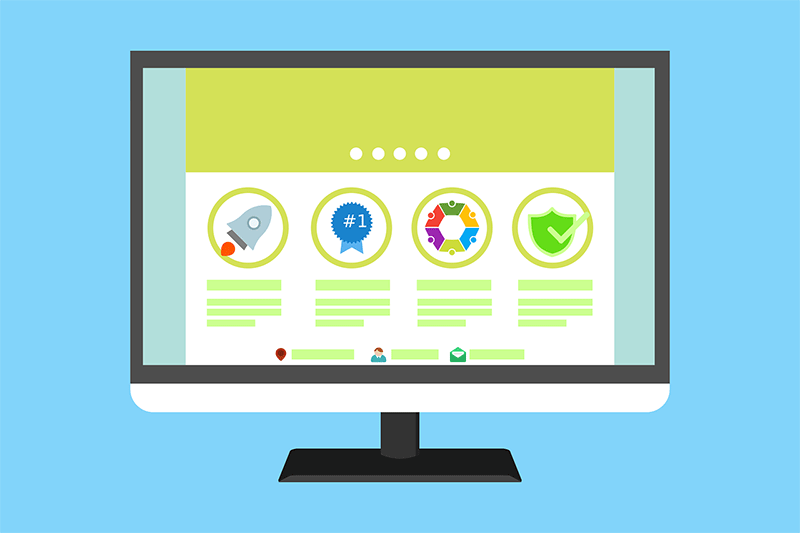
The acronym CMS stands for Content Management System. More precisely, it refers to web software that enables content to be published online in a simplified manner. In short, a CMS is a platform that allows you to create, schedule, and feed your website or blog.
Some Concrete Examples of CMS Platforms
You may already be familiar with certain CMS platforms.



WordPress
The best-known and most widely used platform for blogs and websites is WordPress. It offers a vast range of possibilities, both for beginners and more advanced users.
Joomla
Joomla is another widely used open-source CMS. Supported by a large community and praised for its ease of use, it is one of the most popular CMS platforms available.
Prestashop
Another open-source CMS, Prestashop enables the creation of online shops and is therefore used by a large number of e-commerce websites.
Drupal
Free and open-source, Drupal is also used by thousands of websites worldwide, of all kinds (institutional sites, community websites, blogs, forums, etc.).
What are the Advantages of Using a CMS?
Using a CMS gives you access to creating and managing a website without needing to be an expert in the field or a professional developer. Moreover, CMS platforms — especially the more renowned ones — are often backed by a large online community. You are therefore not alone and can draw on the advice and plugins created by other users. These elements created by other users are tested by them, ensuring a degree of reliability. CMS platforms and the elements they offer are scalable, meaning that a plugin or an additional component can be added to your existing functionality without disruption. For open-source CMS platforms, you can change provider easily at any time without losing any of the work previously carried out.
The Risks Associated with CMS Platforms

However, using a CMS is not without risk. If you manage your own platform, you must indeed manage potential security vulnerabilities on your site.
Failing to carry out maintenance on your site exposes you significantly to this type of risk. Maintenance consists notably of performing regular updates on your CMS. These updates aim to resolve certain vulnerabilities. Neglecting these updates therefore means accumulating security weaknesses.
Furthermore, many website administrators use weak passwords, thereby exposing themselves to even greater risks. A hacker can thus more easily inject malware (a type of virus) onto a poorly protected site. They would then have the ability to modify the site itself, or even use it as a launchpad to spread their malware across the web. In such a scenario, beyond the obvious problems this creates, Google may blacklist your site. Indeed, in terms of web referencing, security vulnerabilities on a site — and even more so its infection by viruses — have a very negative impact on its ranking.
Another source of potential vulnerabilities: plugins and free pre-built designs. Their free availability may mean that the developer who created them will not maintain them in the long term, a potential cause of vulnerabilities. Likewise, the more popular a plugin or design becomes, the more likely it is to become a target for hackers — allowing them to affect a far greater number of websites.
Furthermore, choosing the wrong tools — particularly those that are not scalable — can become a blocker and prevent updates due to incompatibility with the new version of your site.
Similarly, adding feature upon feature can quickly become problematic and overload your site. In such cases, it is better to stick to bespoke solutions.
How to Secure Your Website
There are several ways to protect yourself from this type of risk. In particular, regularly applying requested updates and patches will help to address certain vulnerabilities. Using more complex credentials is arguably the simplest way to raise the security level of your site. More complex to execute: regularly backing up your CMS. This way, in the event of a problem, you will always have a clean version in reserve.
But of all these options, the simplest and most reliable solution remains a maintenance contract.
You may not have the time or the knowledge to secure your site yourself. If you had it built by a service provider, it is worth knowing that you can request a maintenance contract at the same time.
In this way, the creator of your site will take care of the updates. Beyond simply addressing security vulnerabilities on your CMS, this maintenance contract also entitles you to support in the event of a problem. Indeed, if your site falls prey to spam or viruses, or is completely hacked, your service provider will be able to resolve the problem for you.